


 Home
Home
Prototype vs. Mass Production: Why Your PCB Works in Sample but Fails in Volume
 August 5,2026
1. Material Substitution: What You Specified vs. What You Get
Many PCB manufacturers quote using premium materials, but during mass production, they quietly switch to lower-grade alternatives to protect their margins. The prototype may have used high-quality FR-4 with a Tg of 170°C, but the production run arrives with standard 130°C material.
The difference is invisible to the naked eye—but shows up in reflow soldering (warpage), thermal cycling (delamination), and high-frequency performance (signal loss).
How to prevent it:
Specify brand and grade on your fabrication drawing (e.g., "ShengYi S1000-2M PCB Tg 170°C")
Ask for material certificates with each production batch
Work with suppliers who don't compromise on material quality
2. Process Control: Manual Tuning vs. Automated Consistency
Prototypes are often handled by experienced technicians who manually tune every step—adjusting etch times, calibrating drill depths, and fine-tuning lamination pressure. They can compensate for process variations and deliver a perfect board.
In mass production, the same processes are automated and run at high speed. If the parameters aren't optimized for the specific design, yield drops. What worked in the prototype phase may not scale.
How to prevent it:
Require first-article inspection (FAI) before full production begins
Ask about the manufacturer's process capability (Cp/Cpk values) for critical parameters
Choose suppliers who run statistically controlled processes
3. Testing Coverage: Full Inspection vs. Sampling
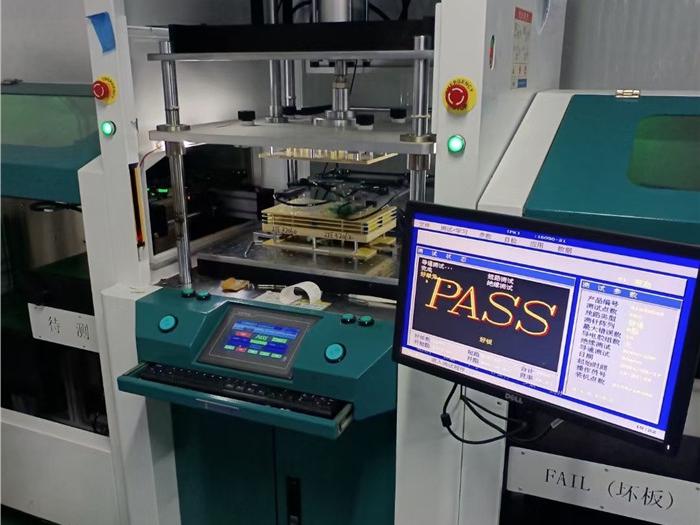
Prototypes are typically 100% inspected. Every board is tested electrically, visually inspected, and often x-rayed. Mass production, however, often relies on statistical sampling—testing only a fraction of the batch.
If the production run has systematic defects, sampling may catch the problem—or it may not. Many failures are discovered only after boards are assembled, costing far more to rework.
Test Type |
Prototype |
Mass Production (Risky) |
Mass Production (Safe) |
Electrical Testing (Flying Probe) |
100% |
Sampling (10-20%) |
100% |
AOI (Automated Optical Inspection) |
100% |
100% |
100% |
X-Ray (for vias/BGAs) |
100% |
Sampling |
100% or targeted |
Impedance Testing |
100% |
Sampling |
100% on critical nets |
How to prevent it:
Specify 100% electrical testing on your purchase order
Require a full test report with each shipment
Work with suppliers who treat testing as a quality guarantee
4. Panelization: The Hidden Variable
Your prototype was likely fabricated as a single unit. In mass production, boards are panelized—multiple units on a single large panel to improve efficiency.
Panelization introduces new variables:
V-CUT or Routing Stress: Separating boards can cause micro-cracks at edges
De-panelization Strain: Components near edges may suffer mechanical stress
Panel Utilization: Poorly designed arrays waste material and drive up cost
How to prevent it:
Work with your supplier to optimize panel design
Ensure fiducial marks and tooling holes are included on every panel
Ask about de-panelization methods compatible with your components
5. Engineering Questions (EQs): The Silent Risk
When you send a prototype order, the supplier's engineers often call with questions: "Your drill size is non-standard—can we adjust?" or "Your impedance requirement is tight—can we relax it?"
In mass production, those questions may be skipped. Production planners assume the prototype's design is final and push the order through without verifying that adjustments were documented.
How to prevent it:
Document every change made during the prototype phase
Include "Lessons Learned" as a formal part of your production notes
Work with suppliers who maintain a detailed engineering history for every design
Quick Reference: Prototype vs. Production Differences
Factor |
Prototype |
Mass Production |
Material |
Premium brand, tightly controlled |
Risk of substitution if not specified |
Process |
Hand-tuned by experienced technicians |
Automated—requires optimized parameters |
Testing |
100% inspection |
Often sampling—specify 100% to be safe |
Panelization |
Single unit or small array |
Complex panel—requires design optimization |
Engineering Review |
Thorough EQ process |
May be skipped—document everything |
6.Final Thoughts
The transition from prototype to mass production is where good designs can become great products—or costly headaches. The difference often comes down to choosing a supplier who understands both phases and treats the scale-up as a collaborative process, not just a repeat order.
By addressing these five areas—material consistency, process control, testing coverage, panelization, and EQ documentation—you can dramatically reduce the risk of production failures. The key is to plan for production from day one, not treat it as an afterthought.
Bicheng PCB bridges the gap between prototype and production. We offer full prototyping and high-volume PCB fabrication with consistent material sourcing, 100% electrical testing, and transparent process documentation. From first article approval to full-scale production, we apply the same rigorous standards at every stage. Contact us to discuss your project.