


 Home
Home
How Does Rogers TMM4 PCB Balance Performance and Practicality for High-Frequency Use?
 April 16,2026
For engineers and manufacturers engaged in high-frequency, precision electronic projects, choosing a PCB that balances performance, reliability, and fabrication ease is essential. Rogers TMM4 high-frequency circuit board, crafted from a ceramic, hydrocarbon, and thermoset polymer composite, stands out with its unique combination of mechanical robustness and electrical stability. This blog explores the core features, benefits, and targeted applications of this PCB, supplemented with accurate technical data and a practical parameter table, catering to European and American clients’ demand for high-quality, compliant high-frequency solutions.
1.What Makes Rogers TMM4 PCB Unique?
Rogers TMM4 laminate is a breakthrough thermoset microwave PCB material, specifically engineered for high plated-thru-hole reliability in strip-line and micro-strip applications—making it an ideal choice for high-frequency circuitry. Unlike traditional PTFE laminates that require specialized production techniques, TMM4 seamlessly integrates the advantages of ceramic (high stability) and PTFE (low loss), while its flexible design balances compactness and performance, suitable for a wide range of precision electronic devices. Additionally, Rogers TMM4 is compliant with EU RoHS and US EPA lead-free standards, eliminating compliance concerns for global manufacturers.
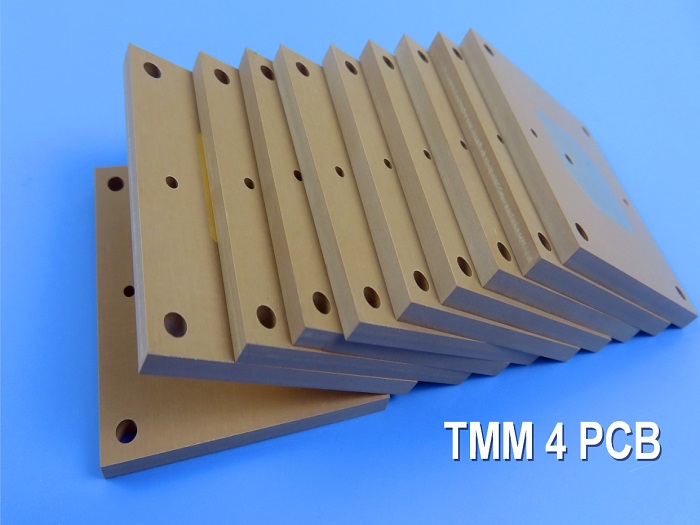
2.Key Properties of Rogers TMM4 PCB
Key Property |
Value |
Benefit for High-Frequency Applications |
Dielectric Constant (Dk) at 10 GHz |
4.50 ± 0.045 |
Ensures precise signal integrity for micro-strip/strip-line designs |
Dissipation Factor (Df) at 10 GHz |
0.0020 |
Minimizes signal loss, maintaining optimal performance in high-frequency operations |
Available Thickness Range |
0.0015 to 0.500 inches |
Offers flexibility for diverse high-frequency PCB design needs |
Thermal Conductivity |
0.7 W/mK |
Ensures effective heat dissipation for high-power components |
Thermal Coefficient of Dk |
15 ppm/°K |
Maintains dielectric stability across varying operating temperatures |
Water Absorption |
0.07%-0.18% |
Preserves structural integrity in diverse environmental conditions |
Decomposition Temperature (Td) |
425°C (TGA) |
Ensures resilience under high-temperature fabrication and operating conditions |
Lead-Free Compatibility |
Yes |
Complies with EU RoHS and US EPA environmental standards |
3.Core Features & Practical Benefits
Rogers TMM4 high-frequency PCB offers targeted features that address key pain points in high-frequency PCB design and fabrication, with each benefit backed by measurable performance data:
First, its stable dielectric performance (Dk 4.50 ± 0.045) ensures precise signal integrity, critical for strip-line and micro-strip applications where impedance control directly impacts performance. The low dissipation factor (0.0020 at 10 GHz) minimizes signal loss, making it ideal for high-frequency circuits that require efficient transmission.
Second, its robust mechanical and thermal stability sets it apart from conventional materials. With a thermal conductivity of 0.7 W/mK and decomposition temperature of 425°C, it withstands demanding operating conditions, while its CTE matched to copper reduces thermal stress during fabrication and use—preventing warpage. Additionally, it is resistant to creep and cold flow, guaranteeing long-term mechanical durability.
Third, it offers easy fabrication and compatibility. Unlike specialized PTFE laminates, TMM4 laminate requires no unique production techniques and seamlessly integrates with common PWB processes. Its high plated through-hole reliability and secure wire-bonding capability (thanks to thermoset resin) reduce fabrication defects, while chemical resistance minimizes damage during processing—lowering production costs for manufacturers.
4.Where Can You Use Rogers TMM4 PCB?
Rogers TMM4 PCB is tailored to specific high-frequency applications favored by European and American industries, leveraging its core features to meet strict performance standards:
In satellite communication systems (used by European and US aerospace companies), its stable dielectric performance ensures reliable signal transmission in extreme space environments. For GPS antennas (deployed in automotive and consumer electronics across the EU and US), its compact design and low signal loss guarantee accurate positioning.
It is also widely used in RF/microwave filters and couplers for telecom infrastructure, where its precise Dk and low Df maintain signal purity. In chip testers (utilized by US and European semiconductor manufacturers), its mechanical durability and high reliability support long-term, high-precision testing operations. Additionally, its compatibility with lead-free processes aligns with regional environmental regulations, making it a seamless choice for global production.
Rogers TMM4 high-frequency PCB balances performance, reliability, and fabrication ease, making it a practical choice for manufacturers seeking high-quality, cost-effective solutions. Its design focuses on solving real-world challenges—signal integrity, thermal stability, and compliance—without overpromising, delivering consistent value for precision high-frequency applications.