


 Home
-
Blog
-
How Does Rogers TC350 Combine 0.72 W/m/K Thermal Conductivity with Simplified Fabrication to Excel in PCBs?
Home
-
Blog
-
How Does Rogers TC350 Combine 0.72 W/m/K Thermal Conductivity with Simplified Fabrication to Excel in PCBs?
How Does Rogers TC350 Combine 0.72 W/m/K Thermal Conductivity with Simplified Fabrication to Excel in PCBs?
 April 8,2026
For engineers and manufacturers focusing on high-frequency, high-power electronic devices, the core features of PCB materials directly determine product performance and fabrication efficiency. Rogers TC350 laminate, a ceramic-filled PTFE-based composite material, boasts targeted core features that address key pain points of traditional PTFE-based PCBs. This blog focuses on the core targeted features of Rogers TC350 PCB, while also introducing its specific applications in line with European and American market demands, ensuring objectivity and no exaggeration.
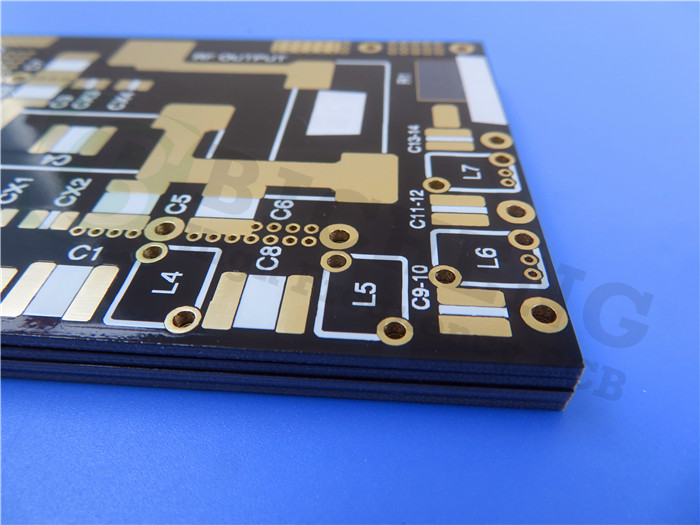
Rogers TC350 2-layer 60mil PCB
1. What Makes TC350 Excel? A Core Advantage Overview
Rogers TC350 is engineered to address common challenges of traditional PTFE-based PCBs, combining low insertion loss and high thermal conductivity—properties that support solid performance in high-power scenarios. Unlike conventional materials, it requires no special through-hole treatments, simplifying fabrication while maintaining good plated through-hole reliability, which helps reduce production costs and improve efficiency. Additionally, its advanced filler system significantly enhances mechanical drilling performance compared to similar laminates, further optimizing the manufacturing process and reducing potential production defects.
Its dielectric constant (Dk) remains stable across a wide frequency and temperature range, with a low thermal coefficient of Dk (-9 ppm/°C) that helps ensure consistent electrical performance even in harsh operating conditions. This stability is important for phase and impedance-sensitive devices like power amplifiers and RF circuits. The material also features a low water absorption rate of 0.05%, which guarantees stable performance in various operating environments, and a high dielectric strength of 650 V/mil, ensuring good insulation between conductor layers.
2. Key Properties at a Glance: Where TC350 Delivers
Key Property |
Value |
Benefit for Applications |
Dielectric Constant (10 GHz) |
3.50 ± 0.05 |
Stable signal transmission |
Dissipation Factor (10 GHz) |
0.0020 |
Low insertion loss, high efficiency |
Thermal Conductivity |
0.72 W/m/°K |
Efficient heat dissipation, reduced operating temperature |
Water Absorption |
0.05% |
Stable performance in various environments |
Dielectric Strength |
650 V/mil |
Good insulation between conductor layers |
Lead-Free Compatibility |
Yes |
Complies with European and American environmental standards |
3. Electrical & Thermal Mastery: How TC350 Handles Power and Signal
Unlike conventional PTFE-based PCB materials, Rogers TC350 high-frequency material has distinct, targeted features that address key pain points in high-power RF manufacturing, with no exaggerated claims—each feature is backed by measurable performance data and practical advantages.
First, its optimized thermal management capability (0.72 W/m/°K thermal conductivity) is specifically designed for high-power scenarios. Compared to standard PTFE laminates (typically 0.3-0.5 W/m/°K), TC350 dissipates heat 40%-70% more efficiently, avoiding component overheating without the need for additional heat sinks. This simplifies PCB design and reduces overall device weight, a key benefit for compact electronic systems.
Second, its stable dielectric performance stands out in high-frequency applications. With a dielectric constant (Dk) of 3.50 ± 0.05 at 10 GHz and a low thermal coefficient of Dk (-9 ppm/°C), it maintains consistent signal transmission even when operating in temperature ranges from -40°C to 125°C. This stability eliminates signal distortion, critical for phase-sensitive RF circuits where impedance consistency directly impacts performance.
Additionally, its low dissipation factor (0.0020 at 10 GHz) minimizes signal loss, ensuring efficient transmission in high-frequency operations. This feature is particularly valuable for precision RF components, where even minor signal loss can compromise overall device performance.
While its electrical and thermal features lay the foundation for high performance, Rogers TC350 also excels in practical fabrication and environmental adaptability, with targeted advantages that complement its core electrical and thermal properties.
4. Built for Real-World Production: Fabrication & Environmental Benefits
TC350 circuit board simplifies fabrication with no special through-hole treatments, reducing steps and defects while maintaining reliability. Its 0.05% water absorption and 650 V/mil dielectric strength ensure stability in harsh environments. The advanced filler system cuts drill wear and hole defects, boosting precision and tool life. Fully lead-free compliant with EU RoHS and US EPA standards, it integrates seamlessly into global production lines without modifications.
These targeted features make Rogers TC350 a reliable choice for manufacturers seeking high-performance, cost-effective high-frequency PCB solutions. Its design focuses on solving practical challenges—thermal management, fabrication complexity, signal stability, and compliance—without overpromising, and it has specific, targeted applications in European and American markets that fully leverage its core features:
In 5G base station high-power amplifiers (widely used in EU and US telecom networks), TC350’s 0.72 W/m/°K thermal conductivity efficiently dissipates heat from high-power operation, ensuring base stations run stably with minimal downtime—critical for telecom operators like Verizon and Vodafone. For aviation broadband antennas (adopted by European and American airlines such as Lufthansa and Delta), its 0.05% water absorption and stable dielectric constant guarantee consistent signal transmission in extreme altitude and temperature changes, meeting strict aviation safety standards.
In industrial high-frequency induction heating equipment (used in US and EU automotive manufacturing), its 650 V/mil dielectric strength ensures safe insulation in high-voltage operations, while lead-free compatibility aligns with EU RoHS and US EPA regulations. For precision RF components (such as power dividers for European industrial control systems), its stable Dk and low Df minimize signal loss, ensuring the accuracy of industrial control signals.