


 Home
Home
PET vs. Polyimide FPC: Which Flexible PCB Substrate Is Right for Your Design?
 April 22,2026
When designing flexible printed circuits (FPCs), selecting the right substrate—either PET (Polyethylene Terephthalate) or Polyimide (PI)—is a critical decision that directly influences the circuit’s performance, durability, cost-efficiency, and suitability for your specific application. For engineers, buyers, and designers, understanding the nuanced differences between these two materials is essential to avoid over-engineering or underperforming designs. Below is a comprehensive, data-driven comparison that breaks down their key attributes, advantages, and ideal use cases. Notably, a high-performance flexible printed circuit is built on polyimide base material with RA copper, a combination widely favored in high-reliability electronics such as automotive, aerospace, and medical devices.
1.Key Performance & Cost Comparison
Parameter |
Polyimide (PI) FPC |
PET FPC |
Max Operating Temp |
-269°C to 260°C (short-term 400°C); suitable for high-temperature manufacturing and harsh environments |
-40°C to 120°C; limited to moderate-temperature applications to avoid deformation |
Reflow Soldering |
Compatible (260°C peak); supports standard SMT assembly processes used in most high-end electronics |
Not recommended (deforms >80°C); requires alternative soldering methods, limiting assembly flexibility |
Flex Life (Cycles) |
Millions (dynamic bending); maintains integrity in applications with frequent movement, such as hinges or wearable devices |
10,000–30,000 (static use); best for applications with minimal or no repeated bending, like static sensors |
Dielectric Constant (Dk) |
3.2–3.5 (1 MHz); low dielectric loss ensures signal integrity in high-frequency applications (5G, aerospace) |
~3.2; similar to PI but less stable at high frequencies, suitable for low-speed, low-frequency circuits |
Moisture Absorption |
1.5–3.0%; requires proper encapsulation for humid environments but remains reliable in most industrial settings |
~0.4% (lower); naturally resistant to moisture, ideal for consumer electronics used in daily, humid conditions |
Cost |
Premium (≈30–40% higher); justified by superior performance and reliability for mission-critical designs |
Cost-effective (30–40% lower); ideal for high-volume, budget-sensitive consumer electronics |
Market Share |
~80% (industry standard); dominant in automotive, aerospace, medical, and high-end consumer electronics |
~20% (entry-level); popular in low-cost consumer goods, simple sensors, and membrane switches |
Typical Thickness |
12.5–125 μm; thinner options available for compact, space-constrained designs (e.g., wearables, microelectronics) |
25–125 μm; thicker minimum thickness limits use in ultra-compact applications |
2.Polyimide (PI) FPC: High-Performance Standard for Demanding Applications
Polyimide (PI) stands as the industry gold standard for flexible printed circuits in demanding environments, and for good reason. Its exceptional thermal stability allows it to withstand extreme temperatures—from cryogenic -269°C to continuous 260°C operation, with short-term resistance up to 400°C—making it compatible with standard reflow soldering processes (260°C peak) used in most high-end electronics manufacturing. This thermal resilience is critical for applications like automotive under-hood electronics, aerospace components, and medical devices, where temperature fluctuations are common. Additionally, PI FPCs offer an ultra-high flex life, supporting millions of dynamic bending cycles without cracking or degradation, which is essential for hinges, wearable technology (e.g., smartwatches), and robotic arms. The polyimide base material with RA copper further enhances performance: RA (Rolled Annealed) copper provides superior conductivity, ductility, and adhesion to the PI substrate, ensuring reliable signal transmission and long-term durability in precision electronics. PI also boasts superior chemical resistance, low dielectric loss, and a UL 94 V-0 flammability rating, making it the top choice for high-reliability, high-frequency, and harsh-environment designs where failure is not an option.
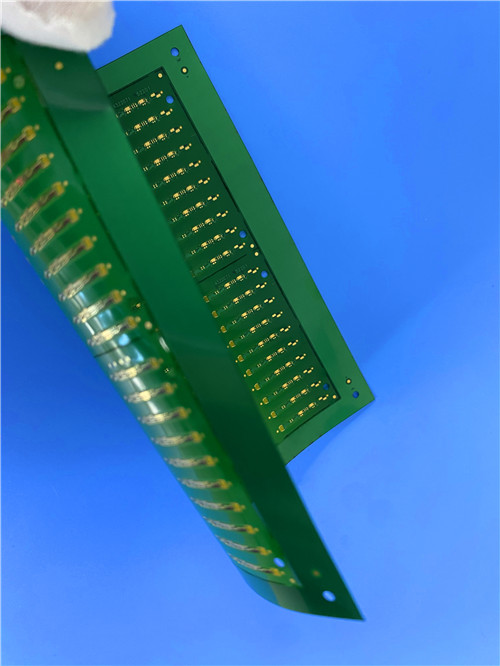
Polyimide-based FPC with RA copper
3.PET FPC: Cost-Effective Entry Solution for Static-Flex Applications
PET (Polyethylene Terephthalate) FPCs excel in cost-sensitive, static-flex or low-dynamic applications where high temperature resistance or extreme flexibility is not required. While PET cannot match PI’s thermal performance—with a maximum operating temperature of 120°C and deformation risk above 80°C—it offers significant advantages for budget-conscious projects. PET provides good electrical insulation, low moisture absorption (≈0.4%, far lower than PI), and optical clarity (clear film options available), making it ideal for consumer electronics like remote controls, LED strips, membrane switches, and simple sensors. Its lower cost (30–40% less than PI) makes it a popular choice for high-volume production, where performance requirements are moderate and cost efficiency is a top priority. PET FPCs are also easier to process in some cases, thanks to their rigidity compared to PI, which can simplify handling during assembly for basic circuits. For applications where the FPC remains mostly static (e.g., internal connections in low-temperature devices), PET delivers reliable performance without the premium price tag of PI.
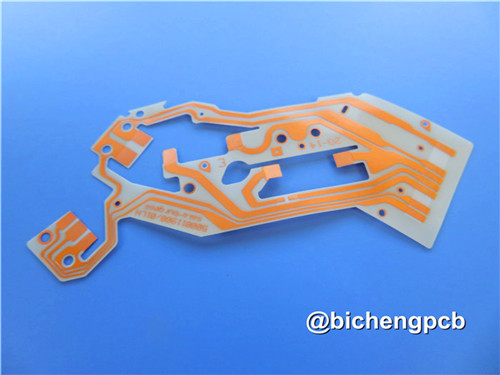
PET FPC
4.Final Takeaway: Choosing the Right FPC Substrate for Your Project
The choice between PI and PET FPCs ultimately comes down to your application’s specific requirements: operating environment, bending needs, performance expectations, and budget. Choose PI FPC for high-temperature, dynamic-flex, and mission-critical designs—especially when leveraging the benefits of polyimide base material with RA copper for enhanced conductivity and reliability. PI is the clear choice for automotive, aerospace, medical, and high-end consumer electronics where durability and performance are non-negotiable. Opt for PET FPC to reduce costs in static, moderate-temperature, high-volume applications such as low-cost consumer goods, simple sensors, and membrane switches. Both materials serve distinct, valuable roles in the FPC industry, and selecting the right one ensures your design is both cost-effective and fit for purpose—critical for success in competitive global markets.