


 Home
-
Blog
-
Can Rogers RT/duroid 5880 Laminate PCB Eliminate Hidden Phase Errors for Millimeter-Wave Phased Array?
Home
-
Blog
-
Can Rogers RT/duroid 5880 Laminate PCB Eliminate Hidden Phase Errors for Millimeter-Wave Phased Array?
Can Rogers RT/duroid 5880 Laminate PCB Eliminate Hidden Phase Errors for Millimeter-Wave Phased Array?
 June 12,2026
For engineers designing millimeter-wave phased array antennas or automotive radar systems, phase consistency across the array is non-negotiable. A few degrees of unexpected phase variation can degrade beamforming accuracy and reduce target resolution.
Many low-loss substrates on the market rely on woven glass reinforcement. While cost-effective, these woven-glass materials introduce a hidden problem: Dk variation depending on glass fiber orientation relative to your traces. This phenomenon, known as fiber weave effect, becomes critically important at frequencies above 30 GHz.
Rogers RT/duroid 5880 laminate solves this problem through a fundamentally different construction method. But how does it achieve what woven-glass materials cannot?
1.The Hidden Problem: Fiber Weave Effect
In woven-glass reinforced substrates, the dielectric constant is not truly uniform across the panel. The glass yarns have a higher Dk (approximately 6.0 to 6.5) than the surrounding resin system (approximately 2.5 to 3.0). As a result, the local Dk seen by a transmission line depends on whether the trace runs over a glass bundle or a resin-rich pocket.
At microwave frequencies, this effect is often negligible. At millimeter-wave frequencies above 30 GHz, however, the electrical wavelength becomes small enough that these local Dk variations cause measurable phase shifts from trace to trace across the same panel.
For phased array applications with hundreds or thousands of elements, these seemingly small phase variations accumulate, leading to degraded sidelobe levels and reduced beam pointing accuracy.
2.How RT/duroid 5880 Eliminates the Problem
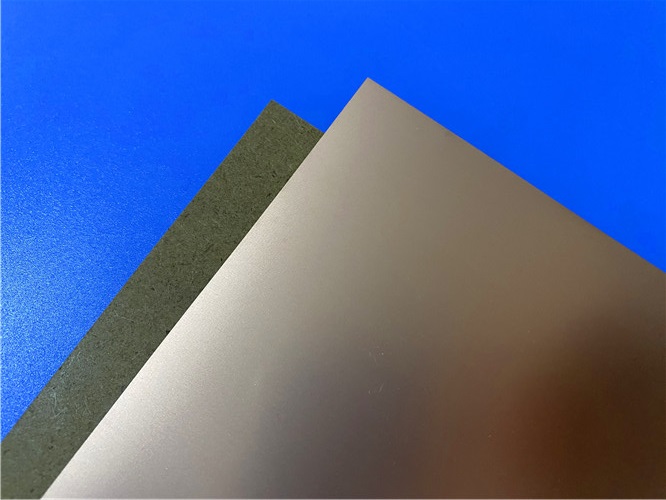
Rogers RT/duroid 5880 substrate uses randomly oriented glass microfibers rather than woven glass fabric. The fibers are dispersed uniformly throughout the PTFE matrix without a repeating weave pattern. This construction creates a truly isotropic material—one where the dielectric constant does not change with direction or location on the panel.
The result is that every trace on a panel of RT/duroid 5880 laminate sees the same Dk, regardless of routing angle or panel position. This consistency translates directly into predictable, repeatable phase performance across large array apertures.
Table 1: RT/duroid 5880 vs. Woven-Glass Substrates
Property |
RT/duroid 5880 |
Standard Woven-Glass Low-Loss Substrate |
Reinforcement Type |
Random microfiber |
Woven glass fabric |
Dk Isotropy |
Truly isotropic |
Anisotropic (fiber orientation dependent) |
Dk Variation Across Panel |
±0.02 typical |
±0.05 to ±0.10 typical |
Phase Consistency Across Array |
Excellent |
Degrades with element count |
Millimeter-Wave Suitability (30-100 GHz) |
Highly suitable |
Limited by fiber weave effect |
Table 2: Typical Applications by Material Type
Application Frequency |
Recommended Substrate |
Why |
Below 10 GHz (e.g., 2.4 GHz, 5.8 GHz) |
Woven-glass or RT/duroid 5880 |
Fiber weave effect minimal |
10-30 GHz (e.g., Ku-band, K-band) |
RT/duroid 5880 preferred for arrays |
Phase variation becomes measurable |
Above 30 GHz (e.g., E-band, automotive radar) |
RT/duroid 5880 strongly recommended |
Fiber weave effect degrades performance |
Space-borne phased arrays |
RT/duroid 5880 |
Consistency and outgassing requirements |
3.Beyond Phase Consistency: Additional Benefits of Random Microfiber Construction
The random microfiber reinforcement of the RT/duroid 5880 laminate offers advantages beyond electrical isotropy.
First, the material eliminates the risk of fiber weave leakage or wicking along glass bundles. In woven-glass materials, moisture or process chemicals can travel along the glass yarns, potentially causing reliability issues over time. The random microfiber construction of the RT/duroid 5880 laminate does not provide continuous pathways for wicking.
Second, RT/duroid 5880 PCB material offers superior dimensional stability in the X-Y plane compared to many woven-glass PTFE substrates. The randomly oriented fibers lock the PTFE matrix in all directions, preventing the differential expansion that can occur when woven fabric relaxes or tensions during lamination.
Third, for laser direct imaging and fine-line etching, the RT/duroid 5880 laminate provides a more uniform surface profile. Woven-glass substrates can exhibit slight surface undulations following the underlying fabric pattern, which becomes problematic for line widths below 75 microns.
4.Where the RT/duroid 5880 Laminate Excels Most
The following applications benefit most directly from the isotropic nature of Rogers RT/duroid 5880 laminate.
Phased array antennas for 5G millimeter-wave base stations require hundreds of elements working in phase coherence. Any element-to-element phase variation reduces effective isotropic radiated power and increases sidelobe interference. The RT/duroid 5880 laminate ensures that phase matching is determined by circuit layout accuracy, not by material inconsistencies.
Automotive radar systems operating at 77 GHz and 79 GHz have extremely short wavelengths. The difference between a 0.1 mm trace routing change and a 0.1 mm shift in local Dk is significant at these frequencies. The RT/duroid 5880 material removes the Dk variation variable, allowing engineers to focus on other design tolerances.
Space-borne synthetic aperture radar systems demand predictable phase behavior across wide temperature swings and after years of operation. The RT/duroid 5880 laminate offers not only isotropy but also low outgassing and moisture absorption of just 0.02 percent.
5.A Note on Fabrication for RT/duroid 5880
Engineers familiar with standard FR-4 or woven-glass PTFE processes should note that Rogers RT/duroid 5880 laminate requires specific fabrication steps. The PTFE matrix is hydrophobic and does not readily accept copper plating without surface activation.
Sodium naphthalate etching or plasma treatment is required before electroless copper deposition. Experienced RF fabricators in European and North American markets are familiar with these processes, but it is essential to select a fabricator with documented PTFE experience. Rogers RT/duroid 5880 material does not support standard FR-4 desmear chemistry, and attempting such processes will result in poor copper adhesion and field failures.
6.Final Thoughts: Why Phase-Predictable Materials Matter for High-Frequency Arrays
For European and North American engineers designing millimeter-wave phased arrays or automotive radar at 77 GHz, Rogers RT/duroid 5880 laminate delivers true electrical isotropy—something woven-glass substrates cannot match.
The random microfiber construction eliminates the fiber weave effect that causes Dk variation with trace angle and panel location. With a Dk tolerance of ±0.02 and a dissipation factor of 0.0009 at 10 GHz, the RT/duroid 5880 material provides ultra-low loss and consistent phase performance across large arrays.
Compared to woven-glass substrates, RT/duroid 5880 RF laminate offers superior phase matching, eliminates wicking pathways, and provides more uniform surfaces for fine-line etching. The trade-offs are higher material cost and the need for specialized PTFE fabrication processes.
If your millimeter-wave designs suffer from unexpected phase variations, examine your substrate. Rogers RT/duroid 5880 laminate PCB removes the fiber weave variable from your design equation. For phased arrays at 30 GHz and above, this predictability is not a luxury—it is a requirement.