


 Home
-
Newly shipped PCBs
-
S1000-2M 16-Layer Heavy Copper PCB: Engineered for Demanding Power and Thermal Applications
Home
-
Newly shipped PCBs
-
S1000-2M 16-Layer Heavy Copper PCB: Engineered for Demanding Power and Thermal Applications
S1000-2M 16-Layer Heavy Copper PCB: Engineered for Demanding Power and Thermal Applications
Printed Circuit Boards are custom-made products; the images and specifications provided are for reference only.
1.Introduction
In the realm of high-power electronics, robust circuit boards capable of handling significant current loads and thermal stress are essential. This 16-layer PCB, constructed with S1000-2M TG180 high-performance laminate, represents a superior solution for applications demanding exceptional reliability, thermal management, and structural integrity. Featuring a substantial 3oz copper weight on every layer, this board is specifically designed to excel in environments where conventional PCBs would be inadequate.
The growing complexity of systems in computing, telecommunications, and automotive electronics has driven the need for boards that not only interconnect components but also act as thermal and structural elements. S1000-2M 16-layer PCB combines advanced material properties with heavy copper construction to meet these challenges, offering designers a dependable platform for high-layer-count, high-power applications.
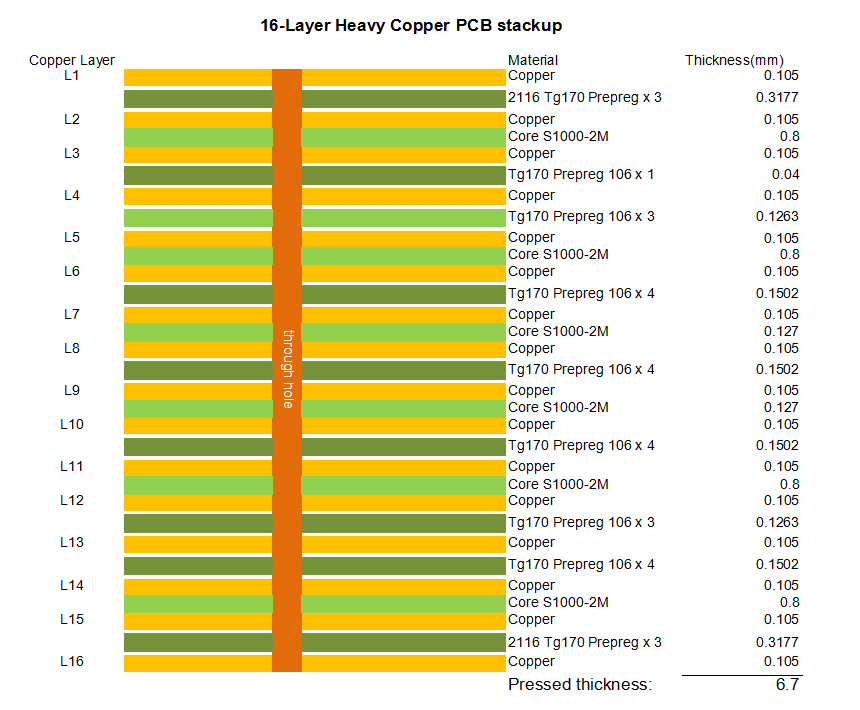
2.Technical Specifications
Parameter |
Specification |
Layer Count |
16 Layers |
Base Material |
S1000-2M / S1000-2MB (FR-4) |
Glass Transition Temperature (Tg) |
180°C |
Copper Weight (All Layers) |
3 oz Finished Copper |
Board Thickness |
6.7 mm |
Surface Finish |
Lead-Free HASL |
Solder Mask & Legend |
Blue Solder Mask, White Silkscreen |
Panel Dimensions |
72 mm × 93 mm (1 Unit per Panel) |
Key Material Property |
Low Z-axis CTE for Excellent Through-Hole Reliability |
Compliance |
Lead-Free Assembly Compatible |
3. Core Material: S1000-2M Laminate
S1000-2M material is a high-Tg, lead-free compatible FR-4 laminate engineered for demanding applications. Its features provide a solid foundation for this heavy copper multilayer board:
Excellent Thermal and Mechanical Reliability: Offers outstanding performance in pressure cooker tests (PCT), low water absorption, and high resistance to heat and humidity, ensuring long-term stability.
Low Coefficient of Thermal Expansion (CTE): Particularly in the Z-axis, this property minimizes stress on plated through-holes during thermal cycling, significantly enhancing board longevity and reliability.
Superior Processability: Provides excellent mechanical processibility and thermal resistance, making it suitable for complex, high-layer-count constructions and compatible with lead-free assembly processes.
4.S1000-2M General properties
Items |
Condition |
Unit |
Property Data |
||
Spec |
Typical Value |
||||
Tg |
DMA |
℃ |
≥ 180 |
185 |
|
Flammability |
C-48/23/50, E-24/125 |
Rating |
V-0 |
V-0 |
|
Volume Resistivity |
After moisture resistance |
MΩ-cm |
≥ 106 |
6.79E+07 |
|
E-24/125 |
≥ 103 |
2.19E+08 |
|||
Surface Resistivity |
After moisture resistance |
MΩ |
≥ 104 |
3.16E+06 |
|
E-24/125 |
≥ 103 |
2.24E+07 |
|||
Arc Resistance |
D-48/50+D-0.5/23 |
S |
≥60 |
133 |
|
Dielectric Breakdown |
D-48/50+D-0.5/23 |
kV |
≥40 |
45kV+NB |
|
Dielectric Constant |
(1GHz) |
C-24/23/50 |
- |
- |
4.6 |
(1MHz) |
C-24/23/50 |
- |
≤5.4 |
4.9 |
|
Dissipation Factor |
(1GHz) |
C-24/23/50 |
- |
- |
0.018 |
(1MHz) |
C-24/23/50 |
- |
≤0.035 |
0.015 |
|
Thermal Stress |
288℃, solder dip |
- |
>10s No Delamination |
>100s No Delamination |
|
Peel Strength (1 Oz) |
288℃/10s |
N/mm |
≥ 1.05 |
1.3 |
|
Flexural Strength |
LW |
Mpa |
≥415 |
567 |
|
CW |
≥345 |
442 |
|||
Water Absorption |
D-24/23 |
% |
≤0.5 |
0.08 |
|
CTE(Z-axis) |
Before Tg |
PPM/℃ |
≤60 |
41 |
|
After Tg |
PPM/℃ |
≤300 |
208 |
||
50-260℃ |
% |
≤3.0 |
2.4 |
||
Td |
Wt5%loss |
℃ |
≥340 |
355 |
|
T260 |
TMA |
min |
≥30 |
60 |
|
T288 |
TMA |
min |
≥5 |
30 |
|
T300 |
TMA |
min |
≥2 |
15 |
|
CTI |
IEC60112Method |
V |
PLC3(175~250) |
PLC3(200V) |
|
Specimen thickness: 1.6mm. Test method is according to IPC-TM-650.
5.Understanding Heavy Copper Technology
What is Heavy Copper?
Heavy copper refers to printed circuit boards that utilize copper weights significantly higher than the standard 1oz or 2oz. Typically, inner or outer layers with copper thicknesses of 3oz per square foot (approximately 105μm) or greater are classified as heavy copper. This design involves specialized etching and plating processes to create robust circuit traces and planes.
The Role and Benefits of Heavy Copper
Incorporating heavy copper serves several critical functions that extend beyond basic connectivity:
Enhanced Current Carrying Capacity: The primary advantage is the ability to conduct much higher currents without overheating, reducing the risk of trace failure.
Improved Thermal Management: The increased copper mass acts as an effective heat spreader, drawing heat away from power components and dissipating it across the board, thereby improving overall
system thermal performance.
Increased Mechanical Strength: Heavy copper layers add structural rigidity to the PCB, which is particularly beneficial in high-vibration environments or for boards supporting large, heavy components.
Space Efficiency: By allowing higher current in a given trace width, or enabling narrower traces for the same current, heavy copper technology can contribute to more compact board designs. This is especially valuable in complex multilayer designs such as 10-Layer Impedance Controlled PCBs, where routing density and signal integrity are critical.
6.Typical Applications
The unique advantages of heavy copper construction make it indispensable in several high-demand sectors:
Power Conversion Systems: Including UPS systems, industrial power supplies, and inverter controls.
Automotive Electronics: Particularly in electric vehicle powertrains, battery management systems, and high-current distribution modules.
Computing and Telecommunications: For server power backplanes, high-performance computing clusters, and network infrastructure equipment.
Industrial Controls and Drives: Motor controllers, welding equipment, and renewable energy systems like solar inverters and wind turbine converters.
7.Summary
S1000-2M 16-layer heavy copper PCB is engineered to deliver unmatched performance in high-power and high-reliability scenarios. The combination of S1000-2M's low CTE and environmental resistance with the superior current-handling and thermal dissipation of 3oz copper creates a board built for endurance. Its 6.7mm thickness and robust construction ensure stability in multi-layer applications, while the lead-free HASL finish guarantees compatibility with modern assembly requirements.
For engineers designing next-generation power systems, computing infrastructure, or automotive electronics, this PCB offers a proven, reliable foundation that balances electrical performance, thermal management, and mechanical durability.
Founded in 2003, Shenzhen Bicheng Electronics Technology Co., Ltd is an established high frequency PCB supplier and exporter in Shenzhen, China, serving customers worldwide.
We are devoted to delivering high-frequency PCB products and solutions of the highest quality, along with customized service. Get in touch with us to start your project !
Visit https://www.bicheng-enterprise.com to learn more.