


 Home
-
Newly shipped PCBs
-
Rogers RO3206 2-Layer 25mil High Frequency PCB for Automotive and Wireless Systems
Home
-
Newly shipped PCBs
-
Rogers RO3206 2-Layer 25mil High Frequency PCB for Automotive and Wireless Systems
Rogers RO3206 2-Layer 25mil High Frequency PCB for Automotive and Wireless Systems
Printed Circuit Boards are custom-made products; the images and specifications provided are for reference only.
1. Rogers RO3206 PCB
Rogers RO3206 PCB represents an advanced extension of the RO3000 series, utilizing ceramic-filled laminates with woven fiberglass reinforcement to deliver exceptional electrical performance and mechanical stability. Rogers RO3206 high-frequency PCB materials are engineered to provide superior mechanical rigidity for easier handling while maintaining competitive pricing. The improved dimensional stability and consistent material properties make RO3206 PCBs ideal for complex multi-layer structures and high-reliability applications across automotive and wireless communications sectors.
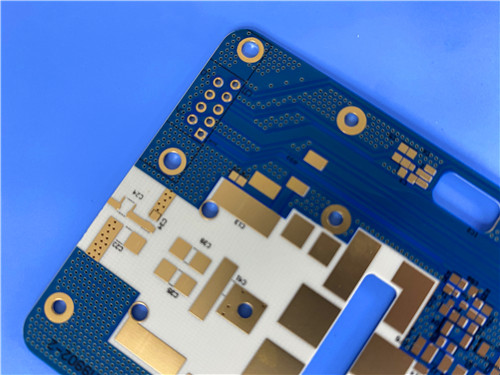
2. PCB Construction Details
Specification Category |
Details |
Base Material |
Rogers RO3206 |
Layer Count |
2 Layers |
Board Dimensions |
63mm x 45mm (±0.15mm) |
Finished Thickness |
0.75mm |
Copper Weight |
1 oz Outer Layers |
Min. Trace/Space |
4/4 mils |
Min. Hole Size |
0.3mm |
Blind Vias |
None |
Surface Finish |
Immersion Gold |
Solder Mask |
Blue (Top), None (Bottom) |
Silkscreen |
White (Top), None (Bottom) |
Electrical Test |
100% |
3. Stackup Structure
This 2-layer configuration employs a Rogers RO3206 core with 0.635mm (25mil) thickness, positioned between two 35μm copper layers to create a reliable 0.75mm profile optimized for high-frequency signal integrity and mechanical durability.
4. Board Statistics
Components: 21
Total Pads: 43 (25 Thru-Hole, 18 Top SMT)
Vias: 22
Nets: 2
Files: Gerber RS-274-X
Standard: IPC-Class-2
Availability: Worldwide
5. RO3206 Material Features
Dielectric Constant: 6.15±0.15 @ 10GHz
Dissipation Factor: 0.0027 @ 10GHz
Thermal Conductivity: 0.67 W/mK
CTE: X 13/Y 13/Z 34 ppm/°C
Copper Peel Strength: 10.7 lbs/in
Moisture Absorption: <0.1%
Woven Fiberglass Reinforcement
6. RO3206 Key Benefits
Enhanced mechanical rigidity for improved handling
Uniform electrical and mechanical performance
Low dielectric loss for superior high-frequency operation
Matched in-plane CTE to copper for reliable assemblies
Excellent dimensional stability ensuring high production yields
Cost-effective solution for volume manufacturing
Superior surface smoothness enabling finer line etching
7. Typical Applications
Automotive Collision Avoidance Systems
GPS and Satellite Antennas
Wireless Telecommunications Infrastructure
Microstrip Patch Antennas
Direct Broadcast Satellites
Data Link Systems
LMDS and Wireless Broadband
Base Station Equipment
Remote Meter Reading Systems
Power Backplanes