


 Home
Home
RO3000 vs RO3200 Series PCBs: How Woven Glass Elevates High-Frequency PCB Performance
 May 27,2026
If you have ever handled a non-woven PTFE laminate, you know the feeling. The board flexes more than expected. It demands careful handling to avoid scratches and dents. Panel sizes are limited because larger panels become difficult to process without damage.
Enter RO3200 series. Designed as an extension of the RO3000® series with one distinguishing characteristic—improved mechanical stability—RO3200 laminates add woven glass reinforcement while maintaining electrical performance comparable to their non-woven counterparts.
This article compares RO3000 and RO3200 series materials side by side, then examines a specific 4-layer hybrid PCB construction using RO3210 cores and RO4450F bondply.
1.The Core Difference: Woven Glass Reinforcement
The fundamental distinction between RO3000 and RO3200 series is simple: RO3200 adds woven fiberglass reinforcement. RO3000 series uses ceramic-filled PTFE without woven glass, resulting in a homogeneous dielectric with excellent surface smoothness but relatively low mechanical rigidity.
RO3200 series combines two characteristics that normally oppose each other. First, it provides the surface smoothness of a non-woven PTFE laminate, which enables finer line etching tolerances. Second, it delivers the rigidity of a woven-glass PTFE laminate, making the material easier to handle on standard production lines.
What the woven glass changes:
Rigidity: The board feels stiffer. Panel sizes can be larger. Automated handling becomes easier.
Dimensional stability: The glass reinforcement locks the material in place, reducing movement during processing.
Drilling: Woven glass increases drill wear slightly compared to non-woven materials, but this is well understood and manageable.
CTE: The in-plane CTE drops to 13 ppm/°C (versus 17-25 ppm/°C on some RO3000 grades), matching copper even more closely.
What the woven glass does NOT change:
Surface smoothness (RO3200 retains the smooth surface characteristic of non-woven PTFE)
Electrical performance at comparable Dk values
Processing compatibility with standard PTFE fabrication techniques
2.Side-by-Side Material Comparison
Parameter |
RO3003 |
RO3203 |
RO3010 |
RO3210 |
Dk @10GHz (process) |
3.00 ± 0.04 |
3.02 ± 0.05 |
10.2 ± 0.5 |
10.2 ± 0.5 |
Design Dk |
3.16 |
3.15 |
10.8 |
10.8 |
Df @10GHz |
0.0010 |
0.0016 |
0.0022 |
0.0027 |
CTE X/Y (ppm/°C) |
17 / 16 |
13 / 13 |
13 / 17 |
13 / 13 |
CTE Z (ppm/°C) |
25 |
25 |
16 |
34 |
Thermal Conductivity (W/m·K) |
0.50 |
0.51 |
0.78 |
0.81 |
Woven Glass |
No |
Yes |
No |
Yes |
Key observations from the comparison:
At Dk=3.0, Rogers RO3203 laminate has a slightly higher dissipation factor (0.0016 vs 0.0010) than RO3003 laminate. If ultra-low loss is the absolute priority, RO3003 remains the better choice. However, if mechanical stability and handling are important, RO3203 is a strong alternative.
At Dk=10.2, both RO3010 and RO3210 share the same Dk specification. The choice comes down entirely to mechanical requirements. RO3010 offers a lower Z-axis CTE (16 ppm/°C) which benefits plated through-hole reliability, while RO3210 offers lower in-plane CTE (13 ppm/°C) and greater rigidity for handling.
3.The RO3210 + RO4450F 4-Layer Hybrid PCB
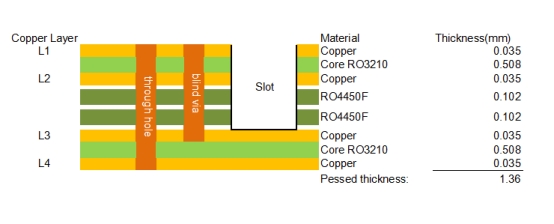
This 4-layer hybrid PCB uses two 0.508mm RO3210 cores bonded with two layers of RO4450F bondply. The structure is symmetrical, with 0.035mm copper on all four layers. Total board thickness is 1.36mm.
The stack-up includes provisions for through holes and blind vias, as well as a slot feature. The two RO4450F bondply layers (0.102mm each) provide a total bonding thickness of 0.204mm, which ensures reliable lamination and sufficient resin flow for via filling.
Why this specific stack-up?
Using RO3210 for both cores eliminates CTE mismatch between layers. The symmetrical construction (same copper weight and core thickness on top and bottom) minimizes warpage risk during reflow assembly. All four layers carry 1 oz finished copper (equivalent to 0.035mm), providing consistent current-carrying capability across the board.
4.Understanding RO4450F Bondply
RO4450F™ is a thermoset bonding film from Rogers' RO4400® series. It was originally formulated for multi-layer structures using RO4000® series cores, but it is fully compatible with RO3200 series materials.
Property |
RO4450F Value |
Significance |
Dk @10GHz |
3.52 ± 0.05 |
Much lower than RO3210 (10.2); acts as electrical isolation between cores |
Df @10GHz |
0.0040 |
Acceptable for inner-layer signal and power distribution |
Z-axis CTE (0-100°C) |
50 ppm/°C |
Supports PTH reliability |
Water Absorption |
0.09% |
Stable in humid environments |
Lead-free compatible |
Yes |
Withstands 260°C peak reflow |
Why RO4450F rather than a PTFE bondply?
Thermoset bondplys like RO4450F process under standard multi-layer press cycles at approximately 175°C. PTFE bondplys often require higher temperatures and more complex processing. For this hybrid PCB where the cores are PTFE-based but the bondply is thermoset, the overall manufacturing process remains accessible to standard PCB fabrication shops.
The use of two 0.102mm RO4450F layers (rather than a single thicker layer) provides better resin flow and fill during lamination, reducing the risk of voids around through-holes and blind vias.
5.Thermal and Mechanical Performance of RO3210
The woven glass reinforcement in RO3210 directly affects its thermal expansion behavior. The X and Y axis CTE of 13 ppm/°C closely matches copper's CTE of approximately 17 ppm/°C. This match has two practical consequences. First, copper traces and plated features remain dimensionally stable during thermal cycling. Second, the PCB does not experience significant warpage during lead-free assembly reflow.
The Z-axis CTE of 34 ppm/°C compares favorably to non-woven PTFE materials, which can exceed 100 ppm/°C in the Z-axis. Lower Z-axis expansion directly translates to higher plated through-hole reliability under thermal cycling.
Thermal conductivity of 0.81 W/m·K is higher than RO3003 (0.50 W/m·K) and significantly higher than standard FR4 (approximately 0.3 W/m·K). Heat spreads more effectively through the dielectric, reducing hot spots under power-dissipating components.
The decomposition temperature of 500°C exceeds typical lead-free assembly peak temperatures (260°C) by a wide margin, ensuring material stability during multiple reflow cycles.
6.Surface Smoothness: The Best of Both Worlds
One concern with woven glass laminates is surface roughness. Woven glass fibers can create a textured surface that interferes with fine-line etching. RO3200 series addresses this by combining woven glass reinforcement with a smooth surface finish.
The result: the rigidity of a woven-glass PTFE laminate with the surface smoothness of a non-woven PTFE laminate. For designers requiring fine-line etching tolerances—such as tightly coupled filters or high-density antenna arrays—this surface characteristic directly supports manufacturing yields.
7.Fabrication Considerations
This RO3210 + RO4450F hybrid PCB can be processed using standard PTFE circuit board processing techniques as described in Rogers' application note "Fabrication Guidelines for RO3000 Series High Frequency Circuit Materials."
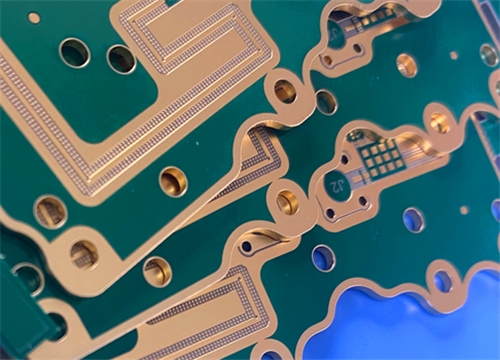
The 1.36mm total thickness is compatible with standard drilling equipment. The two RO4450F bondply layers provide adequate resin volume for via filling and reliable interlayer connection. The symmetrical construction minimizes warpage risk. The off-white color of RO3210 provides good contrast for automated optical inspection.
Practical advantage: The increased rigidity of RO3210 reduces handling damage during panel transport, automated optical inspection, and lamination lay-up. For high-volume production, this translates to higher yields and fewer handling-related defects.
8.When to Choose RO3000 vs RO3200
Choose RO3000 series when:
Ultra-low dissipation factor is the highest priority (RO3003 with Df=0.0010)
The application demands the most homogeneous dielectric possible
Panel sizes are small and handling is carefully controlled
Choose RO3200 series when:
Mechanical rigidity and handling robustness are important
Larger panel sizes are desired for production efficiency
The PCB will go through automated handling equipment
CTE matching to copper is critical (13 ppm/°C in-plane)
The application requires a Dk of 10.2 (RO3210) with improved mechanical stability
For this 4-layer hybrid PCB, RO3210 is the appropriate choice.
9.Conclusion
The RO3000 and RO3200 series share the same fundamental technology—ceramic-filled PTFE for high-frequency performance. The difference lies in mechanical design. RO3200 adds woven glass reinforcement to improve rigidity and handling without sacrificing the surface smoothness that enables fine-line etching.
This 4-layer hybrid PCB uses two 0.508mm RO3210 cores bonded with two 0.102mm RO4450F layers. Total thickness is 1.36mm with 0.035mm copper on all layers. The woven glass construction provides in-plane CTE of 13 ppm/°C closely matching copper, improved rigidity for automated handling, surface smoothness for fine-line etching, and Dk of 10.2 ± 0.5 with Df of 0.0027.
If your design demands a Dk of approximately 10 and you need a PCB material that handles more like FR4 than delicate PTFE, RO3210 is the engineered answer.