


 Home
-
Newly shipped PCBs
-
Rogers TMM10i Double-Sided PCB 30mil Low Loss PCB with Immersion Tin for Microwave Circuitry
Home
-
Newly shipped PCBs
-
Rogers TMM10i Double-Sided PCB 30mil Low Loss PCB with Immersion Tin for Microwave Circuitry
Rogers TMM10i Double-Sided PCB 30mil Low Loss PCB with Immersion Tin for Microwave Circuitry
Printed Circuit Boards are custom-made products; the images and specifications provided are for reference only.
1. Rogers TMM10i PCB Introduction
RogersTMM10i PCB utilizes isotropic thermoset microwave material in a double-sided configuration with 0.8mm thickness. This ceramic thermoset polymer composite features immersion-tin surface finish and provides excellent plated through-hole reliability for stripline and microstrip applications. With a stable dielectric constant of 9.80 and isotropic properties, TMM10i PCB combines the benefits of ceramic substrates with the processability of soft materials, making it ideal for RF and microwave circuitry.
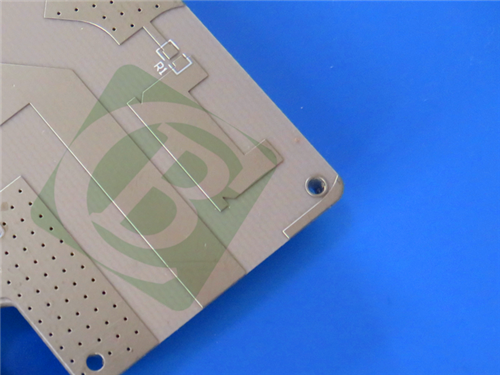
2. PCB Construction Details:
Base Material: Rogers TMM10i
Layer Count: Double-Sided
Board Dimensions: 70mm × 75mm = 1PCS, ±0.15mm
Minimum Trace/Space: 6/4 mils
Minimum Hole Size: 0.3mm
No Blind Vias
Finished Board Thickness: 0.8mm
Finished Cu Weight: 1oz (1.4 mils)
Via Plating Thickness: 20 μm
Surface Finish: Immersion Tin
Top Silkscreen: No
Bottom Silkscreen: No
Top Solder Mask: No
Bottom Solder Mask: No
100% Electrical Test Before Shipment
3. PCB Stackup: 2-Layer Rigid PCB
Copper Layer 1 - 35 μm
Rogers TMM10i Core - 0.762 mm (30mil)
Copper Layer 2 - 35 μm
4. PCB Statistics:
Components: 10
Total Pads: 35
Thru Hole Pads: 19
Top SMT Pads: 16
Bottom SMT Pads: 0
Vias: 15
Nets: 2
5. Artwork Format: Gerber RS-274-X
6. Quality Standard: IPC-Class-2
7. Availability: Worldwide
8. TMM10i Material Features:
Dielectric Constant: 9.80 ± 0.245
Dissipation Factor: 0.0020 @10GHz
Thermal Coefficient of Dk: -43 ppm/°K
CTE: X-axis 19 ppm/K, Y-axis 19 ppm/K, Z-axis 20 ppm/K
Thermal Decomposition Temperature: 425°C
Thermal Conductivity: 0.76 W/mK
Isotropic Dielectric Properties
Ceramic Thermoset Composite
9. Material Benefits:
Excellent Mechanical Stability
Chemical Resistance
No Sodium Napthanate Treatment Required
Reliable Wire Bonding Capability
Stable Thermal Properties
Consistent Electrical Performance
Easy Processing
10. Typical Applications:
RF and Microwave Circuits
Power Amplifiers and Combiners
Filters and Couplers
Satellite Communication Systems
GPS Antennas
Patch Antennas
Dielectric Polarizers and Lenses
Chip Testers