


 Home
-
Newly shipped PCBs
-
4-Layer Hybrid PCB with RO4003C and TG175 FR4 – 1.4mm Low Loss PCB with Controlled Depth Routing for RF and Automotive Radar
Home
-
Newly shipped PCBs
-
4-Layer Hybrid PCB with RO4003C and TG175 FR4 – 1.4mm Low Loss PCB with Controlled Depth Routing for RF and Automotive Radar
4-Layer Hybrid PCB with RO4003C and TG175 FR4 – 1.4mm Low Loss PCB with Controlled Depth Routing for RF and Automotive Radar
Printed Circuit Boards are custom-made products; the images and specifications provided are for reference only.
1. 4-Layer RO4003C + FR4 Hybrid PCB Introduction
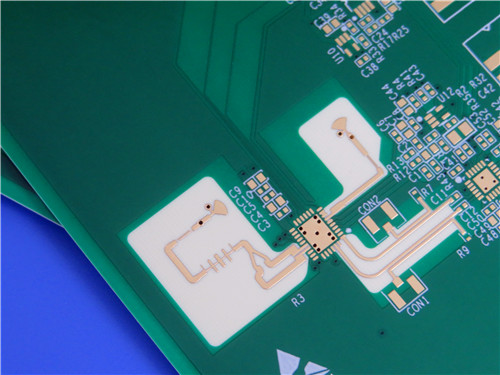
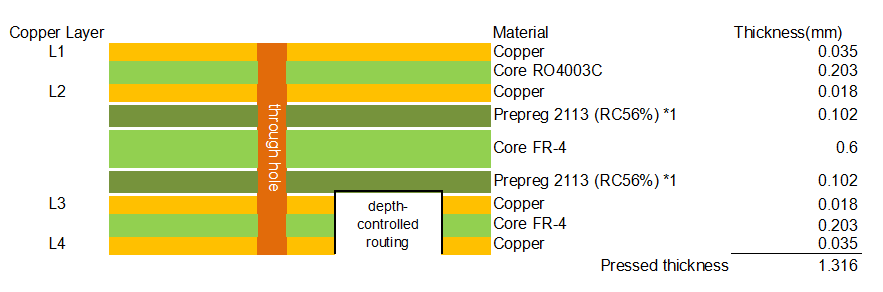
This 4-layer PCB is constructed with a hybrid stackup of RO4003C laminate and FR4 (TG175). The finished board thickness is 1.4 mm, and the panel size is 200 mm × 115 mm (1 piece per panel). Inner layer copper starts at 0.5 OZ, with finished outer copper of 1 OZ. The board features green solder mask, white silkscreen, and immersion gold finish of 2 microinches. Additional specifications include a plated hole copper thickness of 25 µm meeting IPC Class 3 standards, and a controlled depth routing (controlled depth slot) feature.
2. Product Specification
The table below summarizes the main technical parameters of this PCB.
Parameter |
Value / Description |
Layer count |
4 layers |
Material |
RO4003 + FR4 (TG175) hybrid stackup |
Finished board thickness |
1.4 mm |
Board dimensions |
200 mm × 115 mm (1 piece) |
Inner layer copper (starting) |
0.5 OZ |
Finished outer copper |
1 OZ |
Solder mask |
Green |
Silkscreen |
White |
Surface finish |
Immersion Gold (2 microinches) |
Plated hole copper thickness |
25 µm |
IPC standard |
Class 3 (IPC-3) |
Special feature |
Controlled depth routing (slot) |
Controlled depth routing allows precise cavities or partial slots for component recessing or shielding. The 25 µm hole copper thickness ensures reliable plated through-holes. Immersion gold provides a flat, solderable, oxidation-resistant surface.
3.RO4003C Laminate Introduction
RO4000® series hydrocarbon ceramic laminates are designed for superior high-frequency performance while enabling low-cost circuit fabrication. Unlike PTFE-based materials, RO4000 laminates are rigid thermoset resins reinforced with glass fabric. They can be processed using standard epoxy/glass (FR-4) processes, making them cost-competitive for volume production.
RO4003C is a specific grade within the RO4000 series. It offers low dielectric loss, stable dielectric constant (Dk) over frequency, and a very low thermal coefficient of dielectric constant (TCDk). The material has a Tg >280°C (536°F), ensuring stable expansion across circuit processing temperatures. Its CTE is closely matched to copper, providing excellent dimensional stability and reliable plated through-hole quality even under severe thermal shock.
4. Typical Properties
Property |
RO4003C Typical Value |
RO4350B Typical Value |
Direction |
Units |
Condition |
Test Method |
Dielectric Constant, εr (Process) |
3.38 ± 0.05 |
3.48 ± 0.05 |
Z |
- |
10 GHz/23°C |
IPC-TM-650 2.5.5.5 Clamped Stripline |
Dielectric Constant, εr (Design) |
3.55 |
3.66 |
Z |
- |
8 to 40 GHz |
Differential Phase Length Method |
Dissipation Factor tanδ |
0.0027, 0.0021 |
0.0037, 0.0031 |
Z |
- |
10 GHz/23°C, 2.5 GHz/23°C |
IPC-TM-650 2.5.5.5 |
Thermal Coefficient of εr |
+40 |
+50 |
Z |
ppm/°C |
-50°C to 150°C |
IPC-TM-650 2.5.5.5 |
Volume Resistivity |
1.7×10¹⁰ |
1.2×10¹⁰ |
- |
MΩ·cm |
COND A |
IPC-TM-650 2.5.17.1 |
Surface Resistivity |
4.2×10⁹ |
5.7×10⁹ |
- |
MΩ |
COND A |
IPC-TM-650 2.5.17.1 |
Electrical Strength |
31.2 (780) |
31.2 (780) |
Z |
KV/mm (V/mil) |
0.51mm (0.020") |
IPC-TM-650 2.5.6.2 |
Tensile Modulus |
19,650 (2,850), 19,450 (2,821) |
16,767 (2,432), 14,153 (2,053) |
X, Y |
MPa (ksi) |
RT |
ASTM D638 |
Tensile Strength |
139 (20.2), 100 (14.5) |
203 (29.5), 130 (18.9) |
X, Y |
MPa (ksi) |
RT |
ASTM D638 |
Flexural Strength |
276 (40) |
255 (37) |
- |
MPa (kpsi) |
- |
IPC-TM-650 2.4.4 |
Dimensional Stability |
<0.3 |
<0.5 |
X, Y |
mm/m (mils/inch) |
after etch +E2/150°C |
IPC-TM-650 2.4.39A |
Coefficient of Thermal Expansion |
11, 14, 46 |
10, 12, 32 |
X, Y, Z |
ppm/°C |
-55 to 288°C |
IPC-TM-650 2.4.41 |
Tg |
>280 |
>280 |
- |
°C (TMA) |
A |
IPC-TM-650 2.4.24.3 |
Td |
425 |
390 |
- |
°C (TGA) |
- |
ASTM D3850 |
Thermal Conductivity |
0.71 |
0.69 |
- |
W/m/°K |
80°C |
ASTM C518 |
Moisture Absorption |
0.06 |
0.06 |
- |
% |
48 hrs immersion, 0.060" sample, Temperature 50°C |
ASTM D570 |
Density |
1.79 |
1.86 |
- |
g/cm³ |
23°C |
ASTM D792 |
Copper Peel Strength |
1.05 (6.0) |
0.88 (5.0) |
- |
N/mm (pli) |
after solder float, 1 oz. EDC Foil |
IPC-TM-650 2.4.8 |
Flammability |
N/A |
V-0 |
- |
- |
- |
UL 94 |
Lead-Free Process Compatible |
Yes |
Yes |
- |
- |
- |
- |
5. Typical Applications
Cellular base station antennas and power amplifiers
RF identification (RFID) tags
Automotive radar and sensors
Low-noise block downconverters (LNBs) for direct broadcast satellites
Broadband and controlled impedance transmission lines
6. Key Processing Guidelines for RO4003C
The following guidelines are based on Rogers’ recommendations for fabricating double-sided and multi-layer boards using RO4003C laminates. These enable standard FR-4 processes without specialized equipment.
Storage
Store fully clad RO4003C laminates at room temperature (50–90°F / 10–32°C). Use first-in-first-out inventory and track lot numbers through production.
Inner Layer Preparation
Tooling: Compatible with pinned and pinless systems. Slotted pins with multiline tooling and post-etch punching meet most registration needs.
Surface Preparation for Photoresist: Thin cores require chemical cleaning (micro-etch, rinse, dry). Thicker cores work with mechanical scrub systems.
Oxide Treatment: Process through standard copper oxide or oxide-alternative systems per prepreg/adhesive guidelines.
Multi-Layer Bonding
RO4003C laminates are compatible with most thermosetting and thermoplastic adhesive systems. Follow the adhesive supplier’s bond cycle parameters.
Drilling
Avoid drilling speeds above 500 surface feet per minute (SFM).
Recommended chip load: >0.002”/” for mid‑range and large diameter tools; <0.002”/” for small drills (<0.0135” diameter).
Standard geometry drills are preferred over undercut styles for better debris evacuation.
Expected hole wall roughness: 8 to 25 µm, consistent over thousands of hits. Drill wear is normal; quality is determined by ceramic powder distribution, not cutting edge sharpness.
PTH Processing
Desmear: Typically not required for double-sided boards due to high Tg (>280°C). Multi-layer boards may need alkaline permanganate or plasma desmear.
Etchback: Not recommended – it may loosen filler particles near the hole wall.
Metal Deposition: Compatible with electroless copper and direct deposition of conductive layers. For high aspect ratio holes, consider a 0.00025” flash copper plate before imaging.
Copper Plating & Outer-Layer Processing
Compatible with standard acid copper, electrolytic tin or tin/lead plating, and any strip/etch/strip (SES) process. Preserve the post-etch surface for good solder mask adhesion.
Final Metal Finishes
Compatible with OSP, HASL, and most chemically deposited or electroplated finishes (including immersion gold used in this PCB).
Routing and Individualization
Use carbide tools under standard FR-4 routing conditions.
Important: Etch away copper from the routing path to prevent burring.
Maximum stack height for routing: 70% of the actual flute length to allow debris removal.
Circuits can be individualized by dicing, sawing, shearing, routing, or punching. V-scoring and breakaway tabs are also acceptable.
7. What Is a High-Frequency Hybrid PCB?
A high-frequency hybrid PCB combines two or more different laminate materials in a single board. In this product, RO4003C (for RF performance) is bonded with FR4 (TG175) for structural support and cost efficiency. This approach is common when a circuit requires both high-speed signal layers and lower-cost standard layers.
8. Advantages of Hybrid Construction
Optimized Performance: Critical RF paths use low-loss RO4003C, while non-critical sections use standard FR4.
Cost Reduction: Reducing the area of expensive high-performance material lowers total board cost.
Design Flexibility: Mixed dielectrics allow controlled impedance on different layers without over-engineering the entire board.
Reliable Plating: Matched CTE between RO4003C and copper ensures good plated through-hole reliability, even with FR4.
9. Disadvantages and Considerations
Fabrication Complexity: Lamination requires careful temperature and pressure control to avoid warpage or delamination.
CTE Differences: Mismatch between RO4003C and FR4 may cause stress during thermal cycling.
Higher Unit Cost than all-FR4: Although cheaper than all-RO4003C, hybrid boards still cost more than standard FR4.
Limited Supplier Experience: Not all PCB shops are experienced with hybrid stackups.
10. Summary
This 4-layer PCB uses a hybrid stackup of RO4003C and FR4 (TG175) with a finished thickness of 1.4 mm and dimensions of 200 mm × 115 mm. It features 0.5 OZ inner copper, 1 OZ finished outer copper, green solder mask, white silkscreen, and immersion gold (2 microinches). Hole copper thickness is 25 µm, meeting IPC Class 3. A controlled depth routing feature is included. The RO4003C laminate enables high-frequency operation with standard FR-4 processing. Key fabrication guidelines – including storage, drilling (avoid >500 SFM, chip load recommendations, 8–25 µm hole wall roughness), desmear (typically not required for double-sided), no etchback, and routing with copper removed from tool path – are provided to assist reliable manufacturing.