


 Home
-
Rogers PCB
-
RO4360 2-Layer 12mil PCB RO4360G2 High Frequency Circuit Board with ENEPIG For Base Station and Small Cell Transceiver
RO4360 2-Layer 12mil PCB RO4360G2 High Frequency Circuit Board with ENEPIG For Base Station and Small Cell Transceiver
Printed Circuit Boards are custom-made products; the images and specifications provided are for reference only.
1. RO4360G2 PCB Material Introduction
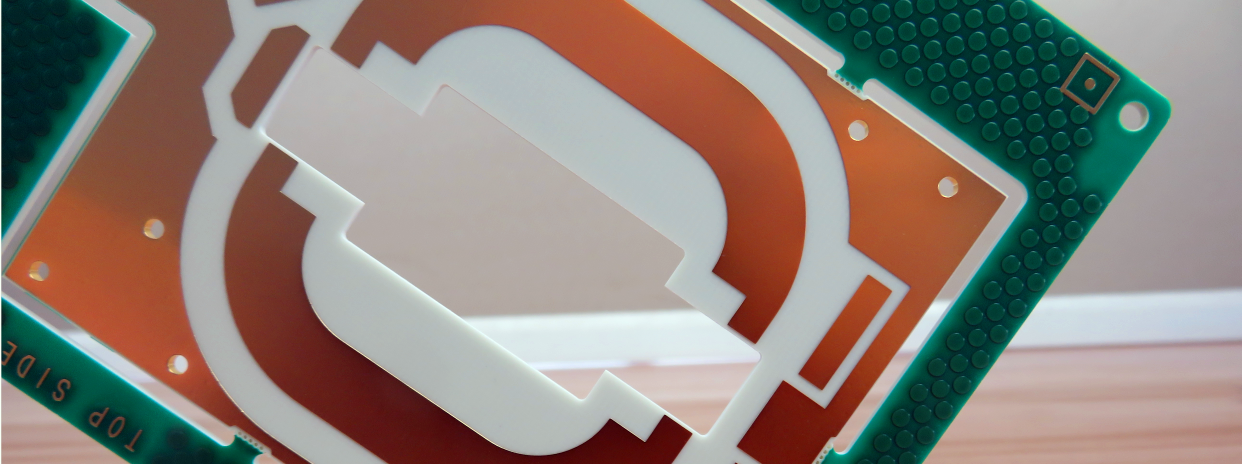
RO4360 high frequency PCB adopts high-performance glass-reinforced, hydrocarbon ceramic-filled thermoset RO4360G2 laminate as the core dielectric material, achieving a perfect balance of superior high-frequency performance and excellent fabrication compatibility. As a high dielectric constant thermoset substrate, RO4360G2 PCB supports FR-4-like processing procedures, which is a key advantage that distinguishes it from traditional high-frequency PCB materials. This lead-free compatible substrate delivers enhanced structural rigidity, greatly improving processing stability for multi-layer PCB constructions while effectively cutting down raw material and manufacturing costs. RO4360 RF circuit board supports hybrid stacking designs with RO440 series prepreg and low-Dk RO4000 series laminates, providing highly flexible and cost-effective solutions for customized multi-layer high-frequency circuit projects.
2. Core Features of RO4360 PCB
- Stable High Dielectric Constant: RO4360 microwave material maintains a stable dielectric constant (Dk) of 6.15 ± 0.15 under 10GHz and 23°C test conditions, ensuring consistent electrical performance and predictable signal transmission behavior for high-frequency circuit designs.
- Low Dissipation Factor: RO4360 laminate features a low dissipation factor (DF) of 0.0038 at 10GHz, minimizing high-frequency signal loss and phase distortion to support efficient RF signal transmission.
- Superior Thermal Resistance: RO4360 PCB substrate achieves a thermal decomposition temperature (Td) higher than 407°C and a TMA glass transition temperature (Tg) over 280°C, delivering outstanding thermal stability during high-temperature soldering and continuous high-power operation.
- High Thermal Conductivity: With a thermal conductivity of 0.75 W/mK, RO4360G2 substrate efficiently dissipates internal heat, preventing thermal accumulation and improving the long-term operational stability of compact high-frequency modules.
- Low Z-Axis Thermal Expansion: RO4360 PCB material owns a low Z-axis thermal expansion coefficient of 28 ppm/°C, effectively reducing layer expansion deformation and enhancing interlayer structural stability during temperature fluctuations.
- Copper-Matched CTE Performance: Optimized in-plane thermal expansion parameters perfectly match copper foil, with X-axis CTE at 13 ppm/°C and Y-axis CTE at 14 ppm/°C within the temperature range of -55°C to 288°C, avoiding circuit cracking and delamination risks.
- Environmental & Safety Compliance: Fully compatible with lead-free manufacturing processes and compliant with UL 94V-0 flammability standards, meeting global environmental protection and electronic safety requirements.
3. Functional Benefits of RO4360 PCB
- Powerful Design Flexibility: Combining FR-4 processing compatibility and high-frequency dielectric performance, RO4360 high frequency PCB supports diverse stackup combinations and customized circuit layouts, adapting to various complex high-frequency product design demands.
- Reliable Plated Through-Hole Performance: Stable thermal expansion and mechanical rigidity ensure the structural integrity of plated through-holes under repeated temperature cycling, greatly improving long-term circuit connection reliability.
- Automated Assembly Compatibility: Consistent dimensional stability and flatness make this RO4360 RF PCB fully suitable for standard automated SMT and assembly production lines, improving mass production efficiency.
- Eco-Friendly Manufacturing: Lead-free process compatible material formula eliminates harmful substances, complying with international environmental regulations and green electronic manufacturing standards.
- Cost-Effective Mass Production: Mature supply chain and shortened production lead times enable low-cost volume manufacturing, balancing premium high-frequency performance and economic benefits for commercial RF applications.
4. PCB Construction Details
| Parameter Item | Specific Specifications |
| Base Material | Rogers RO4360G2 High Frequency Laminate |
| Layer Count | 2-Layer Rigid High Frequency PCB |
| Board Dimensions | 48.9mm x 95.4mm (1PCS) |
| Minimum Trace/Space | 5/7 mils |
| Minimum Hole Size | 0.4mm |
| Blind Vias Design | No Blind Vias |
| Finished Board Thickness | 0.4mm |
| Finished Copper Weight | 1oz (1.4 mils) Outer Layers |
| Via Plating Thickness | 20 μm |
| Surface Finish | ENEPIG (Electroless Nickel Electroless Palladium Immersion Gold) |
| Top Silkscreen | White Silkscreen |
| Bottom Silkscreen | No Silkscreen |
| Top Solder Mask | Green Solder Mask |
| Bottom Solder Mask | No Solder Mask |
| Pre-Shipment Test Standard | 100% Electrical Testing Before Shipment |
5. RO4360 PCB Stackup Structure
RO4360 2-layer rigid PCB adopts a simple and symmetrical stackup layout, delivering balanced mechanical flatness and consistent electrical performance for commercial RF circuit applications:
- Copper Layer 1 – 35 μm
- Rogers RO4360G2 Substrate – 12mil (0.305mm)
- Copper Layer 2 – 35 μm
6. RO4360 PCB Statistical Parameters
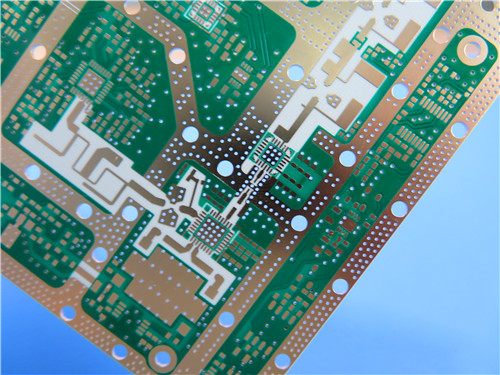
Rogers RO4360G2 PCB features a compact and reasonable circuit layout with precise component and via distribution, meeting the assembly requirements of miniaturized wireless communication devices:
- Total Components: 20
- Total Pads: 34
- Thru Hole Pads: 18
- Top SMT Pads: 16
- Bottom SMT Pads: 0
- Total Vias: 21
- Total Nets: 2
- Production Artwork & Quality Standard of RO4360G2 PCB
RO4360 printed circuit board applies standard Gerber RS-274-X production artwork, which is universally compatible with global PCB manufacturing equipment and processing systems. All fabrication, inspection and quality control procedures strictly comply with IPC-Class-2 industrial quality standards to ensure stable product consistency and assembly reliability. The product supports worldwide supply, providing reliable high-frequency RO4360 PCB solutions for global wireless communication infrastructure projects.
8. Typical Application Fields of RO4360G2 PCB
With high dielectric constant, low signal loss, excellent thermal stability and cost-effective processability, RO4360 PCB is widely applied in commercial wireless communication RF devices:
- Base Station Power Amplifier Circuits
- Small Cell Transceiver Equipment
9. RO4360 PCB DataSheet
| Property | Typical Value | Direction | Units | Condition | Test Method |
| Dielectric Constant, er (Process Specification) | 6.15 ± 0.15 | Z | - | 10 GHz/23°C, 2.5 GHz/23°C | IPC-TM-650 2.5.5.5 (2) Clamped Stripline |
| Dissipation Factor | 0.0038 | Z | - | 10 GHz/23°C | IPC-TM-650, 2.5.5.5 |
| Thermal Conductivity | 0.75 | - | W/m/K | 50°C | ASTM D-5470 |
| Volume Resistivity | 4.0 x 10¹³ | - | Ω•cm | Elevated T | IPC-TM-650, 2.5.17.1 |
| Surface Resistivity | 9.0 x 10¹² | - | Ω | Elevated T | IPC-TM-650, 2.5.17.1 |
| Electrical Strength | 784 | Z | V/mil | - | IPC-TM-650, 2.5.6.2 |
| Tensile Strength | 131 (19) X, 97 (14) Y | X,Y | MPa (kpsi) | 40 hrs 50%RH/23°C | ASTM D638 |
| Flexural Strength | 213 (31) X, 145 (21) Y | X,Y | MPa (kpsi) | 40 hrs 50%RH/23°C | IPC-TM-650, 2.4.4 |
| Coefficient of Thermal Expansion | 13 X, 14 Y, 28 Z | X,Y,Z | ppm/°C | -50°C to 288°C After Replicated Heat Cycle | IPC-TM-650, 2.1.41 |
| Tg | >280 | - | °C TMA | N/A | IPC-TM-650 2.4.24.3 |
| Td | 407 | - | °C | N/A | ASTM D3850 using TGA |
| T288 | >30 | Z | min | 30 min / 125°C Prebake | IPC-TM-650 2.4.24.1 |
| Moisture Absorption | 0.08 | - | % | 50°C/48hr | IPC-TM-650 2.6.2.1, ASTM D570 |
| Thermal Coefficient of er | -131 @ 10 GHz | Z | ppm/°C | -50°C to 150°C | IPC-TM-650, 2.5.5.5 |
| Density | 2.16 | - | gm/cm3 | RT | ASTM D792 |
| Copper Peel Strength | 5.2 (0.91) | - | pli (N/mm) | Condition B | IPC-TM-650 2.4.8 |
| Flammability | V-0 | - | - | - | UL94 File QMTS2.E102763 |
10. RO4360G2 Copper Clad Laminate Knowledge
RO4360 high frequency laminate is an advanced glass-reinforced, hydrocarbon ceramic-filled thermoset material engineered to deliver balanced high RF performance and simplified manufacturability for RO4360 PCB production. As a core member of the reputable RO4000® series material family, RO4360 CCL features a measured dielectric constant of 6.15 and a design dielectric constant of 6.4, enabling circuit miniaturization for size-constrained and cost-sensitive RO4360 PCB applications. This innovative high-Dk laminate expands Rogers high-performance material lineup, supporting lead-free processing, enhanced structural rigidity and stable multi-layer lamination performance while effectively lowering overall material and PCB fabrication costs for mass RO4360 PCB manufacturing. Fully processable like standard FR-4 substrates and compatible with automated assembly lines, RO4360 laminate serves as a high-value, cost-efficient core material for modern commercial RO4360 high frequency PCB designs.

10.1 Core Structural & Processing Characteristics
- Custom RO4000 Thermoset Resin System: RO4360G2 laminate adopts a specially formulated RO4000® thermoset resin system precisely tuned for a stable 6.15 Dk value, delivering consistent electrical repeatability and predictable high-frequency signal performance across mass production batches.
- FR-4 Equivalent Fabrication Ease: Different from traditional high-cost PTFE-based high-frequency materials, RO4360G2 supports standard FR-4 processing workflows, greatly reducing technical barriers, production cycle and manufacturing difficulty for high-frequency PCB fabrication.
- Versatile Hybrid Stackup Compatibility: The laminate supports flexible multi-layer stacking combinations with RO4400 series prepreg and low-Dk RO4000 series core substrates, providing diverse structural design options for customized multi-layer RF PCBs.
- Miniaturization Design Capability: With a practical Dk of 6.15 and design Dk of 6.4, Rogers RO4360G2 laminate allows engineers to shrink circuit dimensions significantly, perfectly adapting to compact and lightweight wireless communication device designs.
- Superior Anti-CAF Performance: The material features excellent Conductive Anodic Filament (CAF) resistance, preventing internal conductive failure and ensuring long-term structural and electrical reliability in high-density and long-service-life PCB applications.
10.2 Integrated Features & Functional Benefits
- Low-Loss High-Frequency Performance: Maintains ultra-low dissipation factor at microwave frequencies, minimizing signal attenuation and phase distortion to support stable and efficient RF signal transmission.
- High Thermal Conductivity & Thermal Stability: Equipped with efficient thermal conductivity and industry-leading high Tg performance consistent with the full RO4000 product line, the laminate resists high-temperature deformation and ensures stable operation during lead-free soldering and continuous high-power working conditions.
- Low Z-Axis CTE for Enhanced Reliability: Optimized low Z-axis thermal expansion coefficient improves plated through-hole integrity under thermal cycling, enhancing structural stability and long-term assembly reliability.
- Excellent Design & Assembly Flexibility: Low Z-axis CTE property delivers abundant design flexibility, while full compatibility with automated assembly lines improves production efficiency and mass manufacturability.
- Cost-Effective Commercial Solution: Compared with traditional high-performance PTFE laminates, RO4360G2 delivers equivalent high-frequency performance at a lower total PCB cost, achieving perfect balance of premium performance and economic benefits.
- Eco-Friendly Lead-Free Compliance: Fully compatible with standard lead-free manufacturing processes, meeting global environmental protection and electronic industry safety standards.
- Efficient Supply Chain & Fast Delivery: Supported by regional finished goods inventory, short lead times and rapid inventory turnover, the material enables flexible scheduling and fast mass production deployment for global projects.
10.3 Main Application Scenarios
Thanks to its miniaturization capability, low-loss performance, FR-4 process compatibility and cost advantages, RO4360G2 copper clad laminate is widely adopted in commercial high-frequency wireless and RF systems:
- Wireless Base Station Power Amplifier Circuits
- Small Cell Wireless Transceiver Equipment
- High-Frequency Patch Antenna Designs
- Ground-Based Radar System Circuit Boards
- General Industrial RF Communication Modules
RO4360 PCB laminate is a premium glass-reinforced hydrocarbon ceramic-filled thermoset substrate designed for cost-sensitive high-frequency RF PCB manufacturing. This innovative high-Dk laminate breaks the limitation of traditional high-frequency materials, combining FR-4 level processing simplicity with professional microwave electrical performance.
RO4360G2 high frequency circuit laminates features enhanced mechanical rigidity and stable thermal properties, supporting multi-layer hybrid lamination with RO440 series prepreg and RO4000 series low-Dk substrates. It provides a highly adaptable and economical material solution for mass production of commercial wireless communication PCBs.
10.1 Core Structural & Processing Characteristics
- FR-4 Compatible Processing Performance: As the first mainstream high-Dk thermoset laminate that supports standard FR-4 fabrication processes, RO4360G2 greatly reduces the processing difficulty and technical threshold of high-frequency PCB production, improving manufacturing efficiency.
- Enhanced Mechanical Rigidity: Glass-reinforced structure improves overall board rigidity, effectively preventing deformation during lamination and assembly, and boosting the yield rate of multi-layer PCB production.
- Flexible Hybrid Stackup Compatibility: The laminate can be freely matched with RO440 series prepreg and low-Dk RO4000 series substrates, supporting diversified multi-layer high-frequency PCB design schemes.
- Lead-Free Process Adaptability: Fully adapted to modern lead-free high-temperature soldering processes, maintaining stable physical and electrical properties without performance degradation.
10.2 Key Material Advantages
- Balanced Performance & Cost: Integrates high-frequency low-loss performance and low-cost processing advantages, solving the high-cost pain point of traditional high-frequency Rogers PCB materials and realizing large-scale commercial application.
- Precise and Stable Dielectric Parameters: Fixed Dk and DF values ensure predictable signal performance, suitable for mass production of standardized communication RF circuit boards.
- Reliable Thermal Structural Stability: Low thermal expansion coefficient and high heat resistance avoid structural and electrical changes caused by long-term equipment operation.
- Green and Environmentally Friendly: Lead-free formula and UL 94V-0 flame retardant grade meet global environmental protection and electronic safety certification standards.
10.3 Main Application Scenarios
Relying on its unique high-Dk, low-loss and process-friendly characteristics, RO4360G2 copper clad laminate is mainly used in commercial wireless infrastructure high-frequency circuit boards:
- Wireless Base Station Power Amplifier PCBs
- Small Cell Wireless Transceiver Circuit Boards
11. Summary
RO4360 2-Layer high frequency PCB is a cost-effective and high-stability commercial RF circuit board built on 12mil RO4360 ceramic-filled laminate. RO4360 0.4mm rigid PCB adopts premium ENEPIG surface finishing, 1oz full outer copper layer and symmetrical double-layer stackup structure, achieving ultra-stable high-frequency signal transmission and reliable mechanical performance. With 5/7mil fine trace spacing, 20μm uniform via plating and 100% pre-shipment electrical testing, RO4360 RF PCB delivers consistent quality and high assembly compatibility. Featuring FR-4-like processability, low thermal expansion and excellent thermal resistance, RO4360 high frequency PCB perfectly fits mass production demands of wireless base station power amplifiers and small cell transceiver devices, becoming an ideal high-performance and cost-efficient solution for commercial microwave communication systems.