

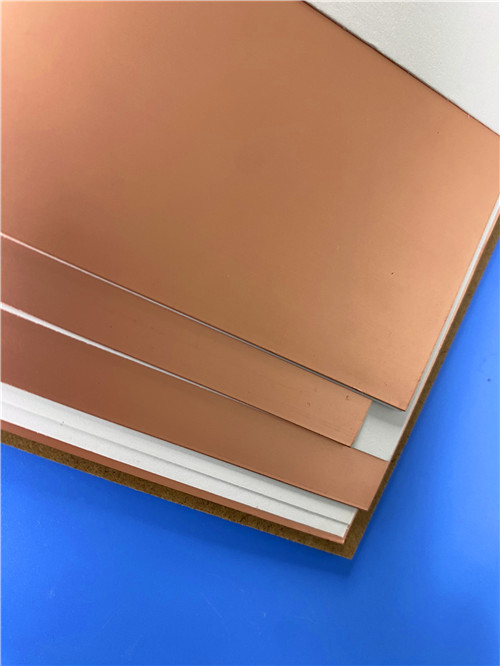
F4BTMS255 High Frequency PCB Material Introduction The F4BTMS255 high frequency material represents a significant upgrade within the F4BTM series, incorporating advanced ceramic loading and ultra-fine glass reinforcement to deliver superior electrical and mechanical performance. This enhanced formulation provides designers with a broader range of dielectric properties while maintaining exceptional dimensional stability and thermal characteristics. Engineered with specialized nano-ceramics uniformly dispersed in a PTFE resin matrix, F4BTMS255 PCB raw material minimizes fiberglass effects during electromagnetic wave propagation. This results in reduced dielectric loss, improved thermal conductivity, and enhanced dimensional stability across all axes. F4BTMS255 laminate exhibits consistent performance through extended frequency ranges with excellent dielectric temperature stability. Featuring RTF low-profile copper foil as standard, F4BTMS255 PCB substrate ensures optimal signal integrity with reduced conductor loss while maintaining strong peel strength. The material supports both traditional and metal-core substrate configurations, offering design flexibility for various thermal management requirements. Compatible with standard PTFE processing techniques, F4BTMS255 enables reliable fabrication of complex multilayer boards, high-density interconnects, and sophisticated backplane designs. Its balanced mechanical properties support fine-line patterning and dense via structures critical for advanced RF systems. As a high-reliability material meeting stringent aerospace requirements, F4BTMS255 provides a dependable domestic alternative to international high-frequency laminates without compromising performance or manufacturability. Product Features - Minimal dielectric constant tolerance and excellent batch-to-batch consistency. - Extremely low dielectric loss. - Stable dielectric constant and low loss within frequencies up to 40GHz, meeting the requirements of phase-sensitive applications. - Excellent temperature coefficient of dielectric constant and dielectric loss, maintaining frequency and phase stability between -55°C and 150°C. - Excellent resistance to radiation, retaining stable dielectric and physical properties even after exposure to irradiation. - Low outgassing performance, meeting the vacuum outgassing requirements for aerospace applications. - Minimal thermal expansion coefficients in the X/Y/Z directions, ensuring dimensional stability and reliable hole copper connections. - Improved thermal conductivity, suitable for high-power applications. - Excellent dimensional stability. - Low water absorption. Models & Data Sheet Here are the technical parameters of the different product models: Product Models: F4BTMS220 F4BTMS233 F4BTMS255 F4BTMS265 F4BTMS294 F4BTMS300 F4BTMS350 F4BTMS430 F4BTMS450 F4BTMS615 F4BTMS1000 Dielectric Constant (Typical): Test Conditions: 10 GHz Values: F4BTMS220: 2.2 F4BTMS233: 2.33 F4BTMS255: 2.55 F4BTMS265: 2.65 F4BTMS294: 2.94 F4BTMS300: 3.00 F4BTMS350: 3.50 F4BTMS430: 4.30 F4BTMS450: 4.50 F4BTMS615: 6.15 F4BTMS1000: 10.20 Dielectric Constant Tolerance: Values: F4BTMS220: +/-0.02; F4BTMS233: +/-0.03; F4BTMS255: +/-0.04; F4BTMS265: +/-0.04; F4BTMS294: +/-0.04; F4BTMS300: +/-0.04; F4BTMS350: +/-0.04; F4BTMS430: +/-0.05; F4BTMS450: +/-0.09; F4BTMS615: +/-0.09; F4BTMS1000: +/-0.12 Dielectric Constant (Design): Test Conditions: 10 GHz Values are the same as the "Dielectric Constant (Typical)" section. Loss Tangent (Typical): Test Conditions: 10 GHz 20 GHz 40 GHz Values: F4BTMS220: 10 GHz: 0.0009 20 GHz: 0.0010 40 GHz: 0.0013 F4BTMS233: 10 GHz: 0.0010 20 GHz: 0.0011 40 GHz: 0.0015 F4BTMS255: 10 GHz: 0.0012 20 GHz: 0.0013 40 GHz: 0.0016 F4BTMS265: 10 GHz: 0.0012 20 GHz: 0.0014 40 GHz: 0.0018 F4BTMS294: 10 GHz: 0.0012 20 GHz: 0.0014 40 GHz: 0.0018 F4BTMS300: 10 GHz: 0.0013 20 GHz: 0.0015 40 GHz: 0.0019 F4BTMS350: 10 GHz: 0.0016 20 GHz: 0.0019 40 GHz: 0.0024 F4BTMS350: 10 GHz: 0.0016 20 GHz: 0.0019 40 GHz: 0.0024 F4BTMS450: 10 GHz: 0.0015 20 GHz: 0.0019 40 GHz: 0.0024 F4BTMS615: 10 GHz: 0.0020 20 GHz: 0.0023 40 GHz: / F4BTMS1000: 10 GHz: 0.0020 20 GHz: 0.0023 40 GHz: / Product Technical Parameters Product Models & Data Sheet Product Features Test Conditions Unit F4BTMS220 F4BTMS233 F4BTMS255 F4BTMS265 F4BTMS294 F4BTMS300 F4BTMS350 F4BTMS430 F4BTMS450 F4BTMS615 F4BTMS1000 Dielectric Constant (Typical) 10GHz / 2.2 2.33 2.55 2.65 2.94 3.00 3.50 4.30 4.50 6.15 10.20 Dielectric Constant Tolerance / / ±0.02 ±0.03 ±0.04 ±0.04 ±0.04 ±0.04 ±0.05 ±0.09 ±0.09 ±0.12 ±0.2 Dielectric Constant (Design) 10GHz / 2.2 2.33 2.55 2.65 2.94 3.0 3.50 4.3 4.5 6.15 10.2 Loss Tangent (Typical) 10GHz / 0.0009 0.0010 0.0012 0.0012 0.0012 0.0013 0.0016 0.0015 0.0015 0.0020 0.0020 20GHz / 0.0010 0.0011 0.0013 0.0014 0.0014 0.0015 0.0019 0.0019 0.0019 0.0023 0.0023 40GHz / 0.0013 0.0015 0.0016 0.0018 0.0018 0.0019 0.0024 0.0024 0.0024 / / Dielectric Constant Temperature Coefficient -55 º~150ºC PPM/℃ -130 -122 -92 -88 -20 -20 -39 -60 -58 -96 -320 Peel Strength 1 OZ RTF copper N/mm >2.4 >2.4 >1.8 >1.8 >1.2 >1.2 >1.2 >1.2 >1.2 >1.2 >1.2 Volume Resistivity Standard Condition MΩ.cm ≥1×10^8 ≥1×10^8 ≥1×10^8 ≥1×10^8 ≥1×10^8 ≥1×10^8 ≥1×10^8 ≥1×10^8 ≥1×10^8 ≥1×10^8 ≥1×10^8 Surface Resistivity Standard Condition MΩ ≥1×10^8 ≥1×10^8 ≥1×10^8 ≥1×10^8 ≥1×10^8 ≥1×10^8 ≥1×10^8 ≥1×10^8 ≥1×10^8 ≥1×10^8 ≥1×10^8 Electrical Strength (Z direction) 5KW, 500V/s KV/mm >26 >30 >32 >34 >40 >40 >42 >44 >45 >48 >23 Breakdown Voltage (XY direction) 5KW, 500V/s KV >35 >38 >40 >42 >48 >52 >55 >52 >54 >55 >42 Coefficientof Thermal Expansion (X, Y direction) -55 º~288ºC ppm/ºC 40, 50 35, 40 15, 20 15, 20 10, 12 10, 11 10, 12 13, 12 12, 12 10, 12 16, 18 Coefficientof Thermal Expansion (Z direction) -55 º~288ºC ppm/ºC 290 220 80 72 22 22 20 47 45 40 32 Thermal Stress 260℃, 10s, 3 times / No delamination No delamination No delamination No delamination No delamination No delamination No delamination No delamination No delamination No delamination No delamination Water Absorption 20±2℃, 24 hours % 0.02 0.02 0.025 0.025 0.02 0.025 0.03 0.08 0.08 0.1 0.03 Density Room Temperature g/cm3 2.18 2.22 2.26 2.26 2.25 2.28 2.3 2.51 2.53 2.75 3.2 Long-Term Operating Temperature High-Low Temperature Chamber ℃ -55~+260 -55~+260 -55~+260 -55~+260 -55~+260 -55~+260 -55~+260 -55~+260 -55~+260 -55~+260 -55~+260 Thermal Conductivity Z direction W/(M.K) 0.26 0.28 0.31 0.36 0.58 0.58 0.6 0.63 0.64 0.67 0.81 Flammability / UL-94 V-0 V-0 V-0 V-0 V-0 V-0 V-0 V-0 V-0 V-0 V-0 Material Composition / / PTFE, Ultra-thin and ultra-fine (quartz) fiberglass. PTFE, Ultra-thin and ultra-fine fiberglass, ceramics. A F4BTMS255 Laminate and Typical Applications: Presented on the screen is an F4BTMS255 high-frequency substrate . F4BTMS255 laminates are extensively employed in various domains, including: Aerospace and aviation equipment, space installations, and cabin setups. Microwave and RF applications. Radar systems, particularly in military applications. Feed networks for signal distribution. Phase-sensitive antennas and phased array antennas. Satellite communications, and much more. Final (F4BTMS series aluminum-based/copper-based boards) This series of laminates can provide aluminum-based or copper-based materials, where one side of the dielectric layer is covered with copper foil, and the other side is covered with an aluminum-based or copper-based layer. This configuration serves as shielding or heat dissipation. The F4BTMS255 high-frequency laminate is designed to meet the rigorous demands of advanced aerospace, defense, and telecommunications applications. With exceptional electrical stability, minimal dielectric variation, and ultra-low loss performance up to 40 GHz, this material ensures consistent signal integrity and phase accuracy in high-frequency systems. Its outstanding thermal and environmental resilience—including radiation resistance, low outgassing, and stable performance across extreme temperatures—makes it a reliable choice for mission-critical designs. Combined with enhanced thermal conductivity, dimensional stability, and moisture resistance, F4BTMS255 high frequency circuit material provides a robust, high-performance foundation for next-generation RF, microwave, and multilayer PCB applications.


 Home
Home