

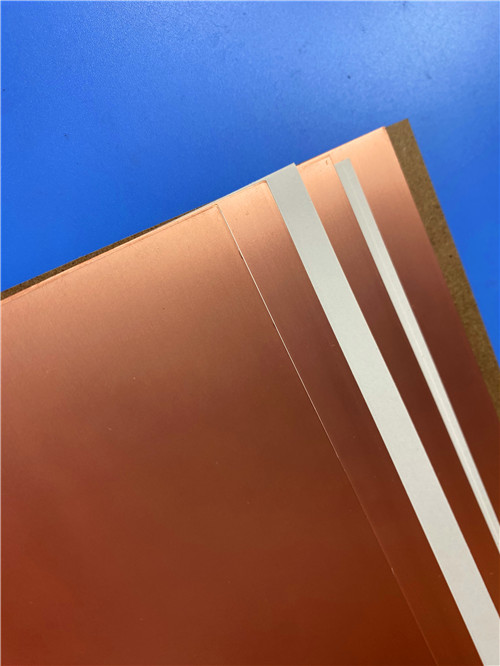
Rogers RT/duroid 6202PR RF PCB Materials Introduction Rogers RT/duroid 6202PR is a high-frequency circuit material that combines low loss and a stable low dielectric constant with superior electrical and mechanical properties. Designed for demanding microwave applications, Rogers RT/duroid 6202PR laminate offers the reliability and performance required for complex structures such as antennas, multi-layer circuits with inter-layer connections, and planar resistor implementations. With its excellent dimensional stability, RT/duroid 6202PR material enables the manufacture of tight-tolerance planar resistors and mechanically robust assemblies. Key Features Low and Stable Dielectric Constant: Dk of 2.94 ±0.04 or 2.98 ±0.04 depending on thickness Excellent High-Frequency Performance: Dissipation factor of 0.002 at 10 GHz Exceptional Thermal Stability: Thermal coefficient of Dk as low as 13 ppm/°C Superior Dimensional Control: Dimensional stability of 0.05 to 0.07 mils/inch Technical Benefits Reliable Assembly Compatibility: In-plane expansion coefficient matched to copper ensures reliable assemblies and interconnections Temperature-Resistant Performance: Ideal for applications sensitive to temperature variations Precision Manufacturing Support: Enables production of tight-tolerance planar resistors and complex circuit structures Design Flexibility: Suitable for both flat and non-planar microwave structures Consistent Performance: Maintains electrical stability across various environmental conditions Typical Properties PROPERTY RT/duroid 6202PR DIRECTION UNITS CONDITION TEST METHOD Thickness Tolerance Dielectric Constant, εr Process and Design [2] 0.005” 2.90 ± 0.04 Z 10 GHz/23°C IPC-TM-650, 2.5.5.5 0.010” 2.98 ± 0.04 0.020” 2.90 ± 0.04 Dissipation Factor, Tan δ 0.0020 Z 10 GHz/23°C IPC-TM-650, 2.5.5.5 Thermal Coefficient of εr +13 ppm/°C 10 GHz /0-100°C IPC-TM-650, 2.5.5.5 Volume Resistivity 1010 Z Mohm•cm A ASTM D257 Surface Resistivity 109 X,Y,Z Mohm A ASTM D257 Tensile Modulus 1007 (146) X,Y MPa (kpsi) 23°C ASTM D638 Ultimate Stress 4.3 % Ultimate Strain 4.9 Compressive Modulus 1035 (150) Z MPa (kpsi) ASTM D638 Moisture Absorption 0.1 - % D24/23 IPC-TM-650, 2.6.2.1 Thermal Conductivity 0.68 - W/mK 80°C ASTM C518 Coefficient of Thermal Expansion 15 X,Y ppm/°C 23°C/ 50% RH IPC-TM-650 2.4.41 30 Z Td 500 °CTGA ASTM D3850 Initial Design Values for Resis- tive Foil Foil Nominal Laminate Nominal ohms/square 25 27 50 60 100 [3] 157 Density 2.1 gm/cm3 ASTM D792 Specific Heat 0.93 (0.22) J/g/K (BTU/lb/°F) Calculated Dimensional Stability 0.07 X,Y mm/m (mil/inch) after etch +E2/150 IPC-TM-650 2.4.3.9 Flammability V-0 UL94 Lead Free Process Compatible Yes A Piece of RT/duroid 6202PR Laminate Typical Applications Planar and non-planar antenna structures Complex multi-layer microwave circuits with inter-layer connections Systems requiring precise planar resistor integration High-frequency applications sensitive to temperature variations Advanced microwave assemblies demanding mechanical reliability and electrical stability Conclusion Rogers RT/duroid 6202PR RF PCB material provides engineers with a proven solution for demanding microwave designs where dimensional stability, thermal performance, and high-frequency characteristics are critical to success. This material delivers consistent, predictable performance that meets the stringent requirements of modern microwave systems through its balanced combination of electrical stability, mechanical reliability, and manufacturing flexibility—making it an ideal choice for engineers developing next-generation high-frequency applications.


 Home
Home