
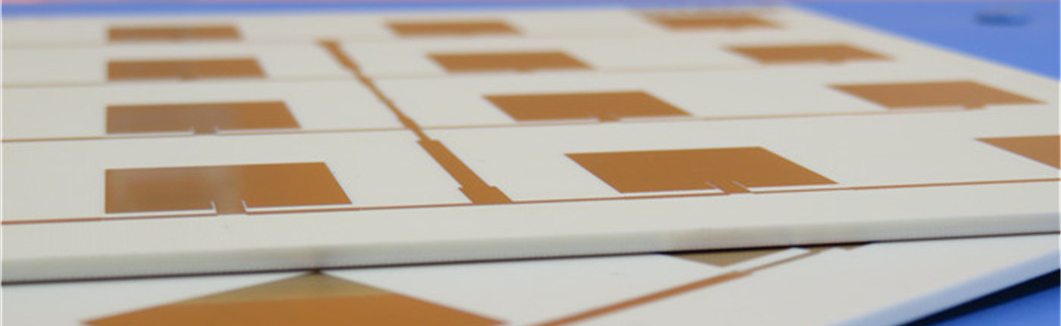
Rogers IsoClad 917 High Frequency PCB Material Introduction Rogers IsoClad 917 laminates are non-woven fiberglass/PTFE composites using a low ratio of fiberglass/PTFE to achieve the lowest 2.17 or 2.20 dielectric constant and 0.0013 dissipation factor. Longer random fibers and proprietary process of IsoClad 917 provide greater dimensional stability and dielectric constant uniformity than competitors in similar classes.It is non-woven fiberglass reinforcement, less rigid than woven fiberglass, so it’s used in applications where the final IsoClad 917 laminate may be bent in shape, including conformal antennas or wrap-around antennas. Features 1.Low dielectric constant (Dk) of 2.17 or 2.20 2. Low dissipation factor of .0013 at 10GHz 3. Extremely low loss 4. Low moisture absorption 5. Highly Isotropic in X, Y and Z Directions Typical Applications: 1.Conformal Antennas 2. Stripline and Microstrip Circuits 3. Guidance Systems 4. Radar Systems Conclusion Rogers IsoClad 917 PCB substrates (Er=2.17–2.20) achieve industry-leading low dielectric constant and dissipation factor through a uniquely balanced, low-ratio PTFE/fiberglass composite structure. Utilizing proprietary processing with longer random fibers, the material delivers superior dimensional stability and dielectric uniformity compared to similar-class laminates. Its non-woven fiberglass reinforcement offers controlled flexibility—less rigid than woven glass variants—making IsoClad 917 ideal for conformal antennas, wrap‑around designs, and other applications where bending or shaping is required. Together, these characteristics position IsoClad 917 as a high‑performance, adaptable solution for demanding RF and microwave systems.
.jpg)


 Home
Home