
.png)
F4BME265 RF PCB Materials Introduction Wangling F4BM265 is a high-performance PTFE-based laminate (core model of the F4BM series) featuring a precisely controlled fiberglass-reinforced blend. Engineered for RF, microwave, and communication applications, F4BM265 laminate delivers stable dielectric properties, ultra-low loss, and reliable signal integrity—making it ideal for multilayer PCBs and temperature-fluctuating environments. Available with RTF copper foil for optimized impedance control, F4BM265 performs exceptionally well in cellular antennas, radar systems, and satellite communication. Catering to high-reliability sectors such as aerospace and defense, F4BM265 laminate supports precision components (including phase shifters and power dividers) and ensures consistent performance at high frequencies. As a trusted domestic solution, it strikes a balance between cost-effectiveness and the quality required for mission-critical designs. Complementing F4BM265, Wangling F4BME265 (F4BME series reinforced model) enhances electrical stability via a fiberglass cloth-PTFE resin-film composition. Equipped with RTF copper, F4BME265 reduces conductor loss and boosts PIM performance, with stable electrical/mechanical properties across temperature variations. F4BME265 PCB raw material is a practical domestic choice for RF, microwave, and select aerospace circuits, widely used in phased array antennas, automotive radar, and satellite systems—aligning with F4BM265’s application scope while offering enhanced reinforcement for demanding scenarios. Features & Benefits -Low DK -Low loss -F4BME paired with RTF copper foil, excellent PIM performance -Diverse sizes, cost-effective -Radiation resistance, low outgassing -Commercialized, large-scale production, high cost-effectiveness Laminate Models and Data Sheet The data sheet provides technical parameters and specifications for a specific product model. It includes various characteristics and performance measurements of the product. This information is essential for potential customers, engineers, and other stakeholders who need to understand the capabilities and limitations of the product. Let's go through the product's technical parameters as mentioned in the data sheet: Dielectric Constant (Typical): Test Conditions: Measured at 10GHz. The dielectric constant values are provided for different product models ranging from F4BME217 to F4BME300. Dielectric Constant Tolerance: The dielectric constant tolerance values indicate the acceptable deviation from the typical dielectric constant for each product model. Loss Tangent (Typical): Test Conditions: Measured at 10GHz and 20GHz. The loss tangent values represent the dissipation of energy within the material at different frequencies for each product model. Dielectric Constant Temperature Coefficient: Test Conditions: Measured over a temperature range from -55ºC to 150ºC. Unit: PPM/℃ (parts per million per degree Celsius). The temperature coefficient values indicate how the dielectric constant changes with temperature for each product model. Peel Strength: Unit: N/mm (Newton per millimeter). The peel strength values represent the bonding strength between different layers of the material for each product model. Volume Resistivity: Test Conditions: Standard conditions. Unit: MΩ.cm (megaohm centimeters). The volume resistivity values indicate the resistance to electric current flow through the material for each product model. Surface Resistivity: Test Conditions: Standard conditions. Unit: MΩ (megaohms). The surface resistivity values indicate the resistance to electric current flow across the surface of the material for each product model. Electrical Strength (Z direction): Test Conditions: Measured at 5KW with a voltage change rate of 500V/s. Unit: KV/mm (kilovolts per millimeter). The electrical strength values represent the ability of the material to withstand electric stress in the Z direction for each product model. Breakdown Voltage (XY direction): Test Conditions: Measured at 5KW with a voltage change rate of 500V/s. Unit: KV (kilovolts). The breakdown voltage values indicate the voltage at which the material fails in the XY direction for each product model. Coefficient of Thermal Expansion: Test Conditions: Measured over a temperature range from -55ºC to 288ºC. Unit: ppm/ºC (parts per million per degree Celsius). The coefficient of thermal expansion values represent the material's dimensional change with temperature in both the XY direction and the Z direction. Thermal Stress: Test Conditions: Measured at 260℃ for 10 seconds, repeated three times. The thermal stress values indicate whether the material experiences delamination under high-temperature conditions for each product model. Water Absorption: Test Conditions: Measured at 20±2℃ for 24 hours. Unit: Percentage (%). The water absorption values indicate the material's ability to absorb water under specific conditions for each product model. Density: Test Conditions: Measured at room temperature. Unit: g/cm3 (grams per cubic centimeter). The density values represent the mass per unit volume of the material for each product model. Long-Term Operating Temperature: Test Conditions: Measured in a high-low temperature chamber. Unit: ℃ (degrees Celsius). The long-term operating temperature values indicate the recommended temperature range for continuous operation of the material for each product model. Thermal Conductivity (Z direction): Test Conditions: Not specified. Unit: W/(M.K) (watts per meter Kelvin). The thermal conductivity values represent the material's ability to conduct heat in the Z direction for each product model. PIM (Passive Intermodulation): Test Conditions: Only applicable to F4BME product model. Unit: dBc (decibels relative to the carrier). The PIM value represents the level of passive intermodulation distortion for the specific product model. Flammability: The flammability values indicate the product's resistance to burning and its compliance with the UL-94 standard. V-0 is the highest rating. Material Composition: This section provides information about the material composition of the product. It states that the product is composed of PTFE (polytetrafluoroethylene) and fiberglass cloth. F4BM is paired with ED (electro-deposited) copper foil, while F4BME is paired with reverse-treated (RTF) copper foil. Product Technical Parameters Product Model & Data Sheet Product Features Test Conditions Unit F4BME217 F4BME220 F4BME233 F4BME245 Dielectric Constant (Typical) 10GHz / 2.17 2.2 2.33 2.45 Dielectric Constant Tolerance / / ±0.04 ±0.04 ±0.04 ±0.05 Loss Tangent (Typical) 10GHz / 0.001 0.001 0.0011 0.0012 20GHz / 0.0014 0.0014 0.0015 0.0017 Dielectric Constant Temperature Coefficient -55ºC~150ºC PPM/℃ -150 -142 -130 -120 Peel Strength 1 OZ F4BM N/mm >1.8 >1.8 >1.8 >1.8 1 OZ F4BME N/mm >1.6 >1.6 >1.6 >1.6 Volume Resistivity Standard Condition MΩ.cm ≥6×10^6 ≥6×10^6 ≥6×10^6 ≥6×10^6 Surface Resistivity Standard Condition MΩ ≥1×10^6 ≥1×10^6 ≥1×10^6 ≥1×10^6 Electrical Strength (Z direction) 5KW,500V/s KV/mm >23 >23 >23 >25 Breakdown Voltage (XY direction) 5KW,500V/s KV >30 >30 >32 >32 Coefficientof Thermal Expansion XY direction -55 º~288ºC ppm/ºC 25, 34 25, 34 22, 30 20, 25 Z direction -55 º~288ºC ppm/ºC 240 240 205 187 Thermal Stress 260℃, 10s,3 times No delamination No delamination No delamination No delamination Water Absorption 20±2℃, 24 hours % ≤0.08 ≤0.08 ≤0.08 ≤0.08 Density Room Temperature g/cm3 2.17 2.18 2.20 2.22 Long-Term Operating Temperature High-Low Temperature Chamber ℃ -55~+260 -55~+260 -55~+260 -55~+260 Thermal Conductivity Z direction W/(M.K) 0.24 0.24 0.28 0.30 PIM Only applicable to F4BME dBc ≤-159 ≤-159 ≤-159 ≤-159 Flammability / UL-94 V-0 V-0 V-0 V-0 Material Composition / / PTFE, Fiberglass Cloth Product Technical Parameters Product Model & Data Sheet Product Features Test Conditions Unit F4BME255 F4BME265 F4BME275 F4BME294 F4BME300 Dielectric Constant (Typical) 10GHz / 2.55 2.65 2.75 2.94 3.0 Dielectric Constant Tolerance / / ±0.05 ±0.05 ±0.05 ±0.06 ±0.06 Loss Tangent (Typical) 10GHz / 0.0013 0.0013 0.0015 0.0016 0.0017 20GHz / 0.0018 0.0019 0.0021 0.0023 0.0025 Dielectric Constant Temperature Coefficient -55ºC~150ºC PPM/℃ -110 -100 -92 -85 -80 Peel Strength 1 OZ F4BM N/mm >1.8 >1.8 >1.8 >1.8 >1.8 1 OZ F4BME N/mm >1.6 >1.6 >1.6 >1.6 >1.6 Volume Resistivity Standard Condition MΩ.cm ≥6×10^6 ≥6×10^6 ≥6×10^6 ≥6×10^6 ≥6×10^6 Surface Resistivity Standard Condition MΩ ≥1×10^6 ≥1×10^6 ≥1×10^6 ≥1×10^6 ≥1×10^6 Electrical Strength (Z direction) 5KW,500V/s KV/mm >25 >25 >28 >30 >30 Breakdown Voltage (XY direction) 5KW,500V/s KV >34 >34 >35 >36 >36 Coefficientof Thermal Expansion XY direction -55 º~288ºC ppm/ºC 16, 21 14, 17 14, 16 12, 15 12, 15 Z direction -55 º~288ºC ppm/ºC 173 142 112 98 95 Thermal Stress 260℃, 10s,3 times No delamination No delamination No delamination No delamination No delamination Water Absorption 20±2℃, 24 hours % ≤0.08 ≤0.08 ≤0.08 ≤0.08 ≤0.08 Density Room Temperature g/cm3 2.25 2.25 2.28 2.29 2.29 Long-Term Operating Temperature High-Low Temperature Chamber ℃ -55~+260 -55~+260 -55~+260 -55~+260 -55~+260 Thermal Conductivity Z direction W/(M.K) 0.33 0.36 0.38 0.41 0.42 PIM Only applicable to F4BME dBc ≤-159 ≤-159 ≤-159 ≤-159 ≤-159 Flammability / UL-94 V-0 V-0 V-0 V-0 V-0 Material Composition / / PTFE, Fiberglass Cloth A F4BME265 Laminate and Typical Applications Displayed on the screen is a F4BME265 copper clad laminates. F4BME265 is a high frequency laminate engineered for demanding RF, microwave, and radar applications. It delivers stable electrical performance and low signal loss, making it an ideal material for phase shifters, power dividers, couplers, combiners, feed networks, phased array antennas, satellite communication systems, and base station antennas. Final - F4BME series aluminum-based/copper-based boards F4BME series laminates can provide aluminum-based or copper-based materials, where one side of the dielectric layer is covered with copper foil, and the other side is covered with either aluminum-based material or copper-based , serving as shielding or heat dissipation purposes.
F4BM paired with ED copper foil, F4BME paired with reverse-treated (RTF) copper foil.
F4BM paired with ED copper foil, F4BME paired with reverse-treated (RTF) copper foil. 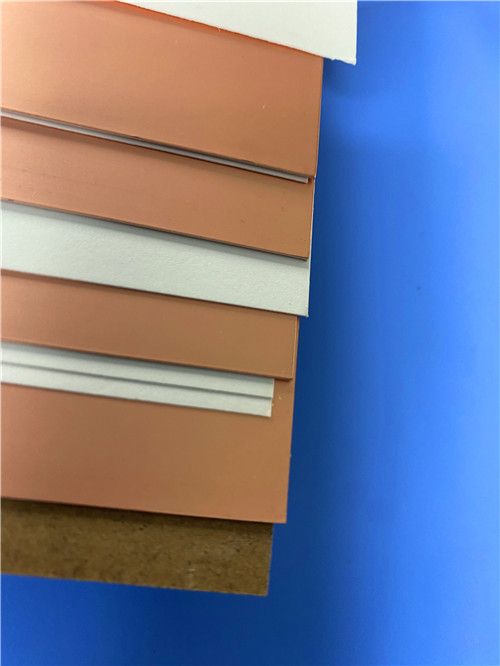


 Home
Home