

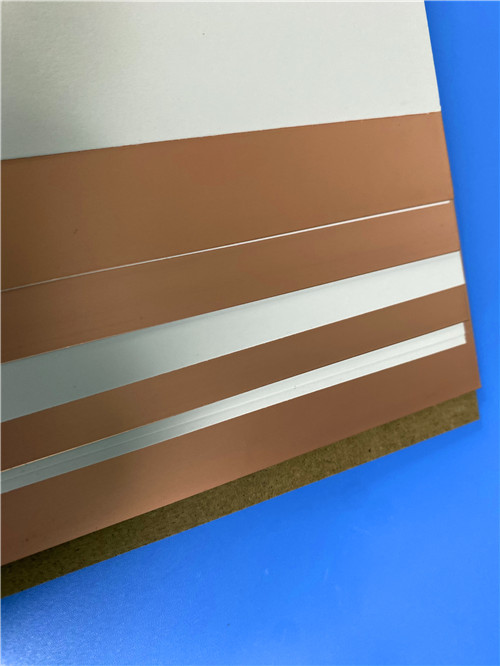
Rogers AD250C High Frequency Laminates Introduction Today, we’re going to talk about a type of commercial microwave and RF laminate material which is designed with low and tight controlled dielectric constant --- AD250C laminate. Rogers AD250C laminates are glass-reinforced, PTFE based materials that provide controlled dielectric constant, low loss performance, and very good PIM performance (passive intermodulation). The woven glass reinforcement affords good circuit processability and enables high yield circuit board fabrication. Now let’s look at the data sheet to get more properties of Rogers AD250C. AD250C Typical Properties This table consists of Electrical Properties, Thermal Properties, Mechanical Properties and Physical Properties. The first column is PIM. Typical PIM values using reverse treated ED copper foil are -159 dBc at 30 mil thickness and -163 dBc at 60 mil thickness. These are typical values obtained using the extensive PIM testing capability at Rogers at 1900 MHz using a two tone, reflected method on a 50Ω microstrip test vehicle. Dielectric constant of process value is 2.52 at 10GHz, design Dk values at 2.5. This particular value is specifically because more and more antenna applications target that dielectric constant number. The dissipation factor at 10GHz is 0.0013, this is considered very low loss. And then TCDk......Thermal Coefficient of Dielectric Constant describes how much the dielectric constant will change with changes in temperature. TCDk at 50 ppm/ºC or less, at absolute value anyway, is considered very good. And this case of AD250C material has -117ppm/ºC TCDk, this can be considered a medium level number. Volume resistivity of 4.8 x 10⁸?Mohm/cm and surface resistivity of 4.1 x 10⁷ Mohm are very good. Electrical strength is 979 V/mil accordance with IPC TM-650 2.5.6.2; Dielectric breakdown is greater than 40 kV. Now let’s look at the thermal properties. Decomposition temperature(Td) exceeds 500ºC measured under the condition of baking 2 hours at 105ºC, 5% weight loss in accordance with IPC TM-650 2.3.40. While the X and Y axes show a median level of thermal expansion coefficient, Z direction seems a little bit poor with 196 ppm/ºC. With 0.33 W/m/K, thermal conductivity is likewise showing a general level. T288 is a good number and lasts longer than 60 minutes. Okay, let’s go on with mechanical characteristics. According to IPC TM-650, the peel strength of 1oz of copper foil after thermal stress is 2.6 N/mm. Flexural strength is 8.8 MPa in machine direction and 6.4 MPa in cross machine direction. Tensile strength is 6.0 MPa in MD and 5.6 MPa in CMD. In MD, the flex modulus is 885 MPa, while in CMD, it is 778 MPa. In the machine direction and cross direction, dimensional stability is 0.02 mils/inch and 0.06 mils/inch, respectively. For mechanical qualities, these data are quite good. Finally, let’s see the physical characteristics. Flammability complies with the 94V0 standard. The amount of moisture absorbed is only 0.04%. Its specific heat capacity is 0.813 J/g K, and its density is 2.28 g/cm3 Electrical Properties AD250C Units Test Conditions Test Method PIM (30mil/60mil) -159/-163 dBc Reflected 43 dBm swept tones at 1900 MHz, S1/S1 Rogers Internal 50 ohm Dielectric Constant (process) 2.52 - 23°C @ 50% RH 10 GHz IPC TM-650 2.5.5.5 Dielectric Constant (design) 2.50 - C-24/23/50 10 GHz Microstrip Differential Phase Length Dissipation Factor (process) 0.0013 - 23°C @ 50% RH 10 GHz IPC TM-650 2.5.5.5 Thermal Coefficient of Dielectric Constant -117 ppm/ºC 0°C to 100°C 10 GHz IPC TM-650 2.5.5.5 Volume Resistivity 4.8 x 10⁸ Mohm-cm C-96/35/90 - IPC TM-650 2.5.17.1 Surface Resistivity 4.1 x 10⁷ Mohm C-96/35/90 - IPC TM-650 2.5.17.1 Electrical Strength (dielectric strength) 979 V/mil - - IPC TM-650 2.5.6.2 Dielectric Breakdown >40 kV D-48/50 X/Y direction IPC TM-650 2.5.6 Thermal Properties Decomposition Temperature (Td) >500 ˚C 2hrs @ 105˚C 5% Weight Loss IPC TM-650 2.3.40 Coefficient of Thermal Expansion - x 47 ppm/˚C - -55˚C to 288˚C IPC TM-650 2.4.41 Coefficient of Thermal Expansion - y 29 ppm/˚C - -55˚C to 288˚C IPC TM-650 2.4.41 Coefficient of Thermal Expansion - z 196 ppm/˚C - -55˚C to 288˚C IPC TM-650 2.4.41 Thermal Conductivity 0.33 W/mK - Z direction ASTM D5470 Time to Delamination >60 minutes as-received 288˚C IPC TM-650 2.4.24.1 Copper Peel Strength after Thermal Stress 2.6 N/mm (lbs/in) 10s @288˚C 35 μm foil IPC TM-650 2.4.8 Flexural Strength (MD/CMD) 8.8/6.4 (60.7/44.1) MPa (ksi ) 25°C ± 3°C - ASTM D790 Tensile Strength (MD/CMD) 6.0/5.6 (41.4/38.6) MPa (ksi ) 23°C/50% RH - ASTM D3039/D3039-14 Flex Modulus (MD/CMD) 885/778 (6,102/5,364) MPa (ksi ) 25°C ± 3°C - IPC-TM-650 Test Method 2.4.4 Dimensional Stability (MD/CMD) 0.02/0.06 mils/inch after etch + bake - IPC-TM-650 2.4.39a Physical Properties Flammability V-0 - - - UL-94 Moisture Absorption 0.04 % E1/105 +D48/50 - IPC TM-650 2.6.2.1 Density 2.28 g/cm3 C-24/23/50 - ASTM D792 Specific Heat Capacity 0.813 J/g°K 2 hours at 105°C - ASTM E2716 A Piece of AD250C Laminate Now on the screen is a AD250C high frequency laminate. Rogers AD250C high frequency circuit materials are typically used in cellular infrastructure base station antennas, automotive telematics antenna systems, commercial satellite radio antennas, and other related applications. Conclusion Passive Intermodulation (PIM) has been a concern in wireless transmission systems since the 1970s. PIM affects systems that use a single antenna for both transmitting and receiving signals on multiple carrier frequencies. In order to minimize PIM generation on the laminates, Rogers determined that high conductor purity and low conductor profile, dielectric formulation and physical qualities, as well as proper control of the conductor-dielectric interface are all properly managed. Antenna designers can be assured of having an opportunity to create an antenna design with the lowest PIM possible. Rogers AD250C PCB material features low values of PIM, better than -157 dBc. OK. This concludes today's episode. Thank you for reading. See you next time.
(IPC TM-650 2.5.5.3)
(14.8)


 Home
Home