
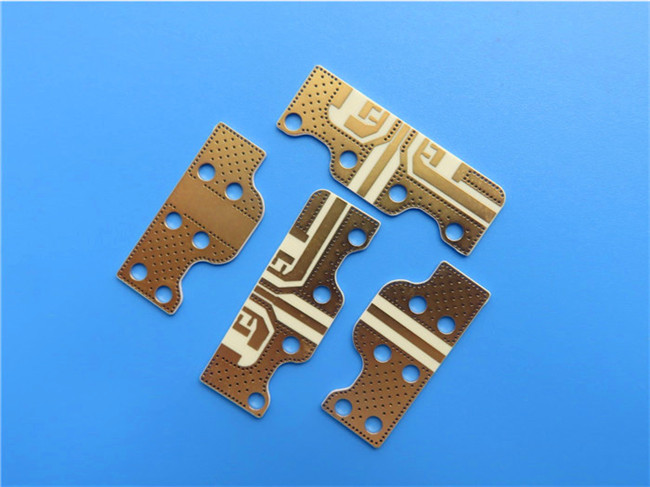
AD1000 High Frequency PCB Material Introduction Greetings and welcome to today’s episode of “AD1000 Microwave Printed Circuit Board Unleashed!” I am your host Jane, the regional sales manager for Bicheng PCB, and today we have an exciting topic to discuss. We'll be diving into the world of advanced substrates for electronic circuits and exploring the remarkable properties of AD1000, Bicheng’s capability on AD1000 etc. What sets AD1000 apart from the rest is its woven-glass reinforced PTFE, which provides unparalleled dimensional stability and mechanical robustness. This means that circuits built on AD1000 can withstand demanding conditions, ensuring reliability and longevity. Rogers AD1000 PCB features high dielectric constant substrate, which is revolutionizing the field of circuit miniaturization and enabling a new era of power amplifiers, filters, couplers, and more. So, let's get started! AD1000 Typical Properties We'll be taking a deep dive into the data sheet of the remarkable AD1000 substrate. We uncover the impressive electrical, thermal, mechanical, and physical properties of this cutting-edge material. 1.Electrical Properties Let's begin by exploring the electrical properties of AD1000. This substrate boasts an exceptional dielectric constant that may vary by thickness. At 1 MHz, the dielectric constant is yet to be determined, while at 10 GHz, it reaches an impressive value of 10.2. In terms of dissipation factor, it exhibits outstanding performance, with values of yet to be determined at 1 MHz and a remarkable 0.0023 at 10 GHz. Another electrical property is the temperature coefficient of dielectric constant, which measures the change in dielectric constant with temperature. AD1000 showcases a temperature coefficient of -380 ppm/℃ at 10 GHz, indicating that the dielectric constant changes significantly with temperature, if your devices or systems rely on a consistent electrical performance, we need to give careful attention to the selection of the materials. As per IPC TM-650 2.5.17.1 standards, AD1000 exhibits remarkable volume resistivity values. At C96/35/90 conditions, it boasts a volume resistivity of 1.40x10^9 MΩ-cm, showcasing its excellent insulating properties. Moreover, at E24/125 conditions, AD1000? maintains an impressive volume resistivity of 5.36x10^7 MΩ-cm. Then the surface resistivity is truly outstanding. At C96/35/90 conditions, it demonstrates a surface resistivity of 1.80x10^9 MΩ, indicating its ability to prevent leakage and ensure reliable insulation. Similarly, at E24/125 conditions, it maintains a surface resistivity of 3.16x10^8 MΩ. According to IPC TM-650 standards, AD1000 impressively withstands an electrical strength of 622 volts per mil, a dielectric breakdown voltage exceeding 45 kV and demonstrates impressive arc resistance, exceeding 180 seconds. 2.Thermal Properties AD1000 excels in thermal properties, which are vital for the reliable operation of electronic systems. With a decomposition temperature exceeding 500℃, this substrate can withstand high-temperature environments without compromising its integrity. It demonstrates T260,T288 and T300 value exceeding 60 minutes. AD1000 also exhibits remarkable thermal expansion characteristics, with a CTE (X, Y) of 8 ppm/℃ and 10 ppm/℃ respectively, and a CTE (Z) of 20 ppm/℃ from 50-150oC. 3.Mechanical Properties AD1000 not only showcases exceptional electrical and thermal properties but also possesses impressive mechanical strength. Its peel strength to copper, even after thermal stress, exceeds 12 lb/in. At elevated temperatures of 150oC, the peel strength remains high at 13.6 lb/in. The substrate's Young's modulus measures an impressive 200 kpsi, indicating its stiffness and resistance to deformation. It also exhibits a flexural strength of 9.9/7.5 kpsi in machine/cross directions, ensuring resilience and durability in demanding applications. AD1000 exhibits an impressive tensile strength of 5.1 kpsi in the machine direction and 4.3 kpsi in the cross direction, highlighting the material's strength and ability to withstand tension forces. It showcases a compressive modulus exceeding 425 kpsi, emphasizing the material's ability to maintain its shape and structural integrity even when subjected to significant compressive loads. 4.Physical Properties Let's explore the physical properties of AD1000. With a water absorption rate of only 0.03%, this substrate demonstrates excellent moisture resistance. Its density at ambient 23oC stands at 3.20 g/cm3, ensuring a lightweight yet robust solution for various electronic applications. Additionally, the thermal conductivity stands at 0.81 W/mK, facilitating efficient heat dissipation and enhancing the overall performance of electronic devices. AD1000 meets the stringent flammability standards, achieving a V0 rating in the UL-94 classification. It also excels in NASA outgassing tests, with minimal total mass loss of 0.01%, collected volatiles of 0.00%, and water vapor recovered of 0.00% at 125oC and ≤10-6 torr. Property Units AD1000 Test Method 1. Electrical Properties Dielectric Constant (may vary by thickness) @ 10 GHz - 10.2 IPC TM-650 2.5.5.5 Dissipation Factor @ 10 GHz - 0.0023 IPC TM-650 2.5.5.5 Temperature Coefficient of Dielectric Constant, TCεr @ 10 GHz (-40-150°C) ppm/℃ -380 IPC TM-650 2.5.5.5 Volume Resistivity C96/35/90 MΩ-cm 1.40x10⁹ IPC TM-650 2.5.17.1 E24/125 MΩ-cm 5.36x10⁷ IPC TM-650 2.5.17.1 Surface Resistivity C96/35/90 MΩ 1.80x10⁹ IPC TM-650 2.5.17.1 E24/125 MΩ 3.16x10⁸ IPC TM-650 2.5.17.1 Electrical Strength Volts/mil (kV/mm) 622 (24.5) IPC TM-650 2.5.6.2 Dielectric Breakdown kV >45 IPC TM-650 2.5.6 Arc Resistance sec >180 IPC TM-650 2.5.1 2. Thermal Properties Decomposition Temperature (Td) Initial ℃ >500 IPC TM-650 2.4.24.6 5% ℃ >500 IPC TM-650 2.4.24.6 T260 min >60 IPC TM-650 2.4.24.1 T288 min >60 IPC TM-650 2.4.24.1 T300 min >60 IPC TM-650 2.4.24.1 Thermal Expansion, CTE (X,Y) 50-150ºC ppm/℃ 8, 10 IPC TM-650 2.4.41 Thermal Expansion, CTE (Z) 50-150ºC ppm/℃ 20 IPC TM-650 2.4.24 3. Mechanical Properties Peel Strength to Copper (1 oz/35 micron) After Thermal Stress lb/in (N/mm) >12 (2.1) IPC TM-650 2.4.8 At Elevated Temperatures (150º) lb/in (N/mm) 13.6 (2.4) IPC TM-650 2.4.8.2 After Process Solutions lb/in (N/mm) IPC TM-650 2.4.8 Young’s Modulus kpsi (GPa) 200 (1.38) IPC TM-650 2.4.18.3 Flexural Strength (Machine/Cross) kpsi (MPa) 9.9/7.5 (68/52) IPC TM-650 2.4.4 Tensile Strength (Machine/Cross) kpsi (MPa) 5.1/4.3 (35/30) IPC TM-650 2.4.18.3 Compressive Modulus kpsi (GPa) >425 (>2.93) ASTM D-3410 Poisson’s Ratio - 0.16 ASTM D-3039 4. Physical Properties Water Absorption % 0.03 IPC TM-650 2.6.2.1 Density, ambient 23ºC g/cm3 3.20 ASTM D792 Method A Thermal Conductivity W/mK 0.81 ASTM E1461 Flammability class Meets V0 UL-94 NASA Outgassing, 125ºC, ≤10-6?torr % NASA SP-R-0022A Total Mass Loss % 0.01 NASA SP-R-0022A Collected Volatiles % 0.00 NASA SP-R-0022A Water Vapor Recovered % 0.00 NASA SP-R-0022A Our PCB Capability (AD1000) This table showcases our extensive PCB manufacturing capability. Conventional double sided boards, multi-layer boards and hybrid designs for a combination of technologies are available in house. Rogers AD1000 PCB provides copper weight of 1oz and 2oz, allowing you to customize the conductivity and current-carrying capacity of your PCB to suit your specific needs. The available dielectric thicknesses include 6mil, 10.5mil, 15mil, 20mil, 25mil, and 30mil to 127mil, offering flexibility in achieving the desired electrical and mechanical characteristics for your application. Our PCBs can be manufactured in various sizes, up to a maximum of 400mm X 500mm, ensuring compatibility with your specific application. Moreover, you have the freedom to choose from a variety of solder mask colors, including green, black, blue, yellow, red, and more, to match your aesthetic preferences or functional requirements. We provide a selection of wide surface finishes, including immersion gold, HASL, immersion silver, immersion tin, OSP, bare copper, pure gold, and ENEPIG etc. PCB Material: Woven Glass Reinforced PTFE/Ceramic Filled Designation: AD1000 Dielectric constant: 10.2 Dissipation Factor 0.0023 10GHz Layer count: Double Sided PCB, Multilayer PCB, Hybrid PCB Copper weight: 0.5oz (17 µm), 1oz (35µm), 2oz (70µm) Dielectric thickness: 6mil (0.1524mm), 10.5mil (0.2667mm), 15mil (0.381mm), 20mil (0.508mm), 25mil (0.635mm), 30mil (0.762mm), 50mil (1.27mm), 59mil (1.499mm), 125mil ( 3.175mm ), 127mil (3.226mm) PCB size: ≤400mm X 500mm Solder mask: Green, Black, Blue, Yellow, Red etc. Surface finish: Immersion gold, HASL, Immersion silver, Immersion tin, OSP,Bare copper, Pure gold, ENEPIG etc.. A Piece of AD1000 PCB Displayed on the screen is a type of AD1000 microwave PCB built on 50mil substrates for radar antenna. Rogers AD1000 PCB was specifically designed to cater to various applications, including miniaturized circuitry for compact devices like GPS receivers, patch antennas requiring smaller sizes, satellite communications systems, power amplifiers (PAs), low noise amplifiers (LNAs), low noise block down converters (LNBs), radar modules and manifolds, aircraft collision avoidance systems (TCAS), and ground-based radar systems. Conclusion AD1000 laminate is classified as a "soft substrate," displaying a notable resistance to vibrational stress. As a result, it enables the implementation of miniaturized circuitry without the need for complex processing or special handling typically associated with fragile materials like pure ceramic or ceramic-hydrocarbon blends. With AD1000, engineers and designers can unlock new possibilities, pushing the boundaries of innovation in various industries. That's all for today's episode of "AD1000 Microwave PCB Unleashed!", I'm your host Jane, and I hope you enjoyed our exploration of the remarkable AD1000 substrate. See you next time.


 Home
Home