



 Home
-
Others
-
Rogers RO3003 4-Layer 2.4mm High-Frequency PCB for Automotive Radar and 5G Communications
Home
-
Others
-
Rogers RO3003 4-Layer 2.4mm High-Frequency PCB for Automotive Radar and 5G Communications
Rogers RO3003 4-Layer 2.4mm High-Frequency PCB for Automotive Radar and 5G Communications
Printed Circuit Boards are custom-made products; the images and specifications provided are for reference only.
Overview of This High-Frequency PCB
This 4-layer RO3003 PCB utilizes Rogers RO3003 ceramic-filled PTFE composite material, designed for demanding RF and microwave applications. With board dimensions of 190mm × 90mm and a finished thickness of 2.4mm, the construction features advanced blind via technology from inner layer 2 to bottom layer, with vias filled and capped for enhanced reliability. Rogers RO3003 PCB employs immersion tin surface finish and maintains precise 4/4 mils minimum trace/space specifications with 0.4mm minimum hole size. Additional mechanical features include 90-degree countersunk holes on the top layer, supporting robust assembly in high-frequency systems operating up to 77 GHz.
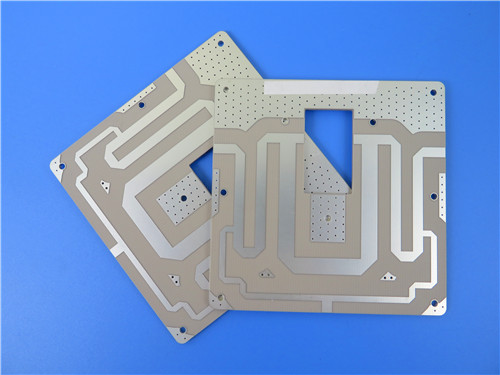
PCB Construction Specifications
Parameter |
Specification |
Base Material |
Rogers RO3003 |
Board Dimensions |
190mm × 90mm |
Board Thickness |
2.4mm |
Minimum Trace/Space |
4/4 mils |
Minimum Hole Size |
0.4mm |
Via Configuration |
Blind vias (Inner layer 2 to Bottom) |
Copper Weight |
1oz (inner/outer layers) |
Via Plating Thickness |
20μm |
Surface Finish |
Immersion Tin |
Solder Mask |
None |
Silkscreen |
White (Top only) |
Special Features |
Countersunk holes (90°) |
Electrical Test |
100% tested |
Additional Components & Features
RO3003 PCB design incorporates 27 components with 73 total pads, comprising 47 through-hole pads and 26 surface mount pads on the top layer. The layout includes 97 vias and 4 nets, providing comprehensive interconnections for complex RF circuitry. The stackup configuration features Rogers RO3003 substrates with 60mil and 20mil thicknesses, separated by RO4450F prepreg material of 4mil thickness, all clad with 35μm copper layers. This hybrid construction ensures optimal signal performance and structural integrity.
Material Advantages
RO3003 laminates deliver consistent dielectric constant stability (3.0±0.04) across temperature and frequency variations, eliminating the Dk step change typically associated with PTFE glass materials near room temperature. The material's low dissipation factor (0.001 at 10 GHz) and 0.5 W/mK thermal conductivity ensure minimal signal loss with adequate heat dissipation. With low moisture absorption (0.04%) and CTE values matched to copper (X:17, Y:16, Z:25 ppm/°C), these laminates provide excellent dimensional stability for reliable multi-layer board performance in varying environmental conditions.
Typical Applications
Rogers RO3003 high-frequency PCB suits automotive radar systems operating at 77 GHz, advanced driver assistance systems (ADAS), and 5G wireless infrastructure including millimeter wave applications. Additional implementations include global positioning satellite antennas, cellular telecommunications power amplifiers and antennas, patch antennas for wireless communications, direct broadcast satellites, and various RF components such as band pass filters and voltage controlled oscillators.
Why Choose This PCB?
The combination of Rogers RO3003 material characteristics with advanced PCB manufacturing techniques delivers a high-frequency solution offering consistent electrical performance, mechanical stability, and cost efficiency. The material's stable dielectric constant across temperature and frequency ranges, coupled with its compatibility with epoxy glass multi-layer hybrid designs, makes it suitable for RF applications requiring precision and reliability in challenging operating environments.
Order Now for Advanced RF Systems!
Rogers RO3003-based PCB solution is available for immediate prototyping and volume production, supporting your high-frequency design requirements with verified performance metrics. Contact us today to discuss how this PCB technology can enhance your automotive radar, 5G infrastructure, or satellite communication applications with reliable high-frequency performance.