

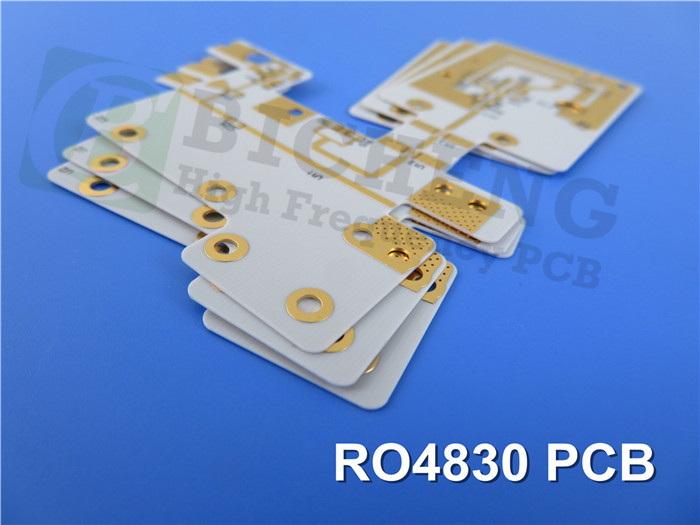
RO4830 High Frequency PCB Material Introduction Hello everyone and welcome back to our channel. Today, we will be diving into an exciting topic - Rogers RO4830 PCBs, a type of thermoset RF printed circuit boards that are perfectly suited for price-sensitive millimeter wave applications, specifically 76-81 GHz automotive radar sensors. Rogers RO4830 laminates are specially designed for the cap layer on FR-4 hybrid multi-layer board commonly used in 76-81 GHz automotive radar sensor PCB applications. The optimized filler, resin, and glass composite system maximizes their performance and durability. Utilizing reverse treated smooth LoPro copper foil, these PCBs offer improved conductivity and reliability. Now let’s explore the detailed properties from the data sheet of RO4830. Features & Benefits One of the standout features of RO4830 laminate is its dielectric constant, which measures at an impressive 3.24 for both 5mil and 9.5mil thickness. This ensures reliable signal performance, making it ideal for applications that require precise and accurate data transmission. At 77 GHz, RO4830 laminate achieves a transmission line loss of only 2.2 or 1.8 dB/in, further enhancing signal integrity and minimizing loss. Another key characteristic of RO4830 is its dissipation factor, which measures at 0.0033 or 0.0032 at 10 GHz. This low dissipation factor indicates minimal energy loss, leading to more efficient power transmission and improved overall performance. Rogers RO4830 PCB also excels in thermal stability, with a thermal coefficient of DK in the z direction measuring at -30 ppm/°C between -50°C to 150°C. This exceptional thermal stability ensures reliable performance even in challenging temperature environments, making it suitable for a wide range of applications. When it comes to strength and durability, RO4830 stands out with its impressive dielectric strength of 78.7 kV/mm or 59.1 kV/mm for 5mil or 9.5mil respectively. These values indicate its ability to withstand high voltages while maintaining structural integrity over extended periods. Water absorption performs very low for both thicknesses. RO4830 laminates also offers excellent peel strength after thermal stress, with a value of 0.67 N/mm for both thickness for their reverse treated ED foil variant. This ensures the integrity of the PCB even under challenging thermal conditions, maintaining reliable performance over time. Safety is another important aspect of any PCB materials, and RO4830 delivers with a V-0 flammability rating according to the UL94 standard. This rating indicates that it exhibits excellent flame retardancy, making it a trusted choice for applications where safety is paramount. In addition to its electrical and thermal properties, RO4830 also boasts excellent dimensional stability. During a 4-hour test at 105°C, 5mil material experiences minimal dimensional changes, with a maximum expansion of -1.8 mm/m in both machine direction and cross-machine direction. This dimensional stability ensures accurate and reliable PCB assembly and performance. Decomposition temperature features as high as 408°C or 412°C for 5mil or 9.5mil. While T288 with copper cladded exceeds 30 minutes for both thicknesses. Furthermore, RO4830 is lead-free process capable, aligning with the industry's push for more environmentally friendly and sustainable manufacturing processes. Thermal conductivity is a crucial factor in PCB materials, and RO4830 delivers with a calculated value of 0.45 W/mK at 50°C?for 5mil thickness. This ensures efficient heat dissipation, preventing overheating and maintaining the overall performance and lifespan of the PCB. Finally, the coefficient of thermal expansion values for 5mil thickness are 23 ppm/°C in the x and y directions and 110 ppm/°C in the z direction. These excellent values significantly contribute to the dimensional stability and plated-through hole reliability in PCBs. Property RO4830 Units Condition Test Method Dielectric Thickness 0.005” 0.0095” Dielectric Constant, εr Design 3.24 3.24 - 77 GHz microstrip differential phase length Transmission Line Loss 2.2 1.8 dB/in 77 GHz microstrip differential phase length Dissipation Factor, tan δ 0.0033 0.0032 - 10 GHz split-post dielctric resonator Thermal Coefficient of εr (z direction) -30 -30 ppm/°C -50°C to 150°C IPC-TM-650 2.5.5.5 Dielectric Strength 78.7 59.1 kV/mm 48 hrs @ 50°C IPC-TM-650, 2.5.6.2 2000 1500 V/mil Water Absorption 0.15 0.13 % D-48/50 ASTM D570 Peel Strength after Thermal Stress 0.67 0.67 N/mm 18 micron reverse IPC-TM-650 2.4.8 3.8 3.8 lbs/in Flammability Rating V-0 V-0 - C-48/23/50 UL94 Dimensional MD -1.8 -1.5 (-1.5) mm/m (mils/in) 4 hrs @ 105°C IPC-TM-650 2.4.39A CMD -1.8 -1.6 (-1.6) Decomposition Temperature 408 412 °C - ASTM D3850 Time to Delamination (T288) >30 >30 minutes with Cu IPC-TM-650, 2.4.24.1 Lead-Free Process Capable YES YES - - - Thermal Conductivity (calculated) 0.45 0.47 W/mK 50°C Through-plane calculation with series CTE x,y 23 21 ppm/°C 0 to 150°C IPC-TM-650 2.4.41 PCB Capability (RO4830) For RO4830 PCBs, we can provide you with single-sided, double-sided, multi-layer, or hybrid PCB configurations. In terms of copper weight, designers have the option to choose between 1oz (35µm) and 2oz (70µm). This flexibility allows for customizing conductivity and managing thermal properties according to the project's unique requirements. Rogers RO4830 PCB supports dielectric thicknesses of 5mil (0.127mm) and 9.4mil (0.239mm), enabling designers to optimize the PCB's overall thickness and performance without compromising their creative visions. As for size limitations, we can accommodate panel sizes of up to 400mm x 500mm. This allows for the manufacturing of larger PCBs or the integration of multiple smaller ones within a single sheet. We offer various solder mask colors, including green, black, blue, yellow, and red. These colors not only add aesthetic appeal but also provide an additional layer of protection and insulation, ensuring the PCB's durability and unwavering reliability. Furthermore, we provide a wide range of surface finish options to meet specific application requirements. These options include immersion gold, HASL, immersion silver, immersion tin, ENEPIG, OSP, bare copper, and pure gold. Each surface finish option caters to different assembly processes, environmental conditions, and solderability needs, ensuring optimal performance and reliability. PCB Capability (RO4830) PCB Material: Hydrocarbon/ Ceramic/ Spread Woven Glass Designation: RO4830 Dielectric constant: 3.24 Dissipation factor 0.0033-0.0032 Layer count: Single Sided, Double Sided, Multi-layer PCB, Hybrid PCB Copper weight: 1oz (35µm), 2oz (70µm) Dielectric thickness 5mil (0.127mm), 9.4mil (0.239mm) PCB size: ≤400mm X 500mm Solder mask: Green, Black, Blue, Yellow, Red etc. Surface finish: Immersion gold, HASL, Immersion silver, Immersion tin, ENEPIG, OSP, Bare copper, Pure gold etc.. RO4830 PCB and Typical Applications On the screen before you, it’s a 9.4mil RO4830 PCB featuring an immersion gold coating. Rogers RO4830 PCB boards find remarkable applications in various fields, including 76-81 GHz automotive radar sensors and automotive radar antennas etc.. Final RO4830 PCB material is a thermosetting hydrocarbon resin system, reinforced with glass and filled with ceramic particles. It is expertly clad with Rogers' proprietary surface modified reverse treat copper foil. Notably, RO4830 laminates possess an advanced anti-oxidant package similar to that of RO4835 laminates, making them remarkably resistant to oxidation compared to other laminate materials based on hydrocarbons. Rogers RO4830 PCBs can be easily routed, punched, V-scored, or laser trimmed using standard epoxy/glass (FR-4) processes. Additionally, they are fully compatible with the RO4400 bondply, providing greater flexibility and convenience in manufacturing. This concludes today’s episode. Thank you for reading. We look forward to seeing you again.
treated EDfoil
Stability
(-1.8)
(-1.8)
mixing rule


 Home
Home